Australasia (1108 – 1251 CE): Southern Worlds…
1108 CE to 1251 CE
Australasia (1108 – 1251 CE): Southern Worlds of Continuity and Adaptation
Between 1108 and 1251 CE the southern hemisphere’s lands—from the cool forests of Aotearoa to the savannas of Arnhem Land and the islands of the Torres Strait—entered a period of cultural flourishing and ecological stability. The Medieval Warm Period tempered the southern climates with mild rains and steady seasons, allowing societies to perfect the arts of adaptation: Māori settlers brought Polynesian horticulture into new latitudes; Aboriginal Australians sustained ancient fire and foraging systems; Torres Strait Islanders forged maritime chiefdoms that bridged Australia and New Guinea. Across the southern oceans, continuity and innovation interwove to create one of the most diverse human mosaics on Earth.
Geographic and Environmental Context
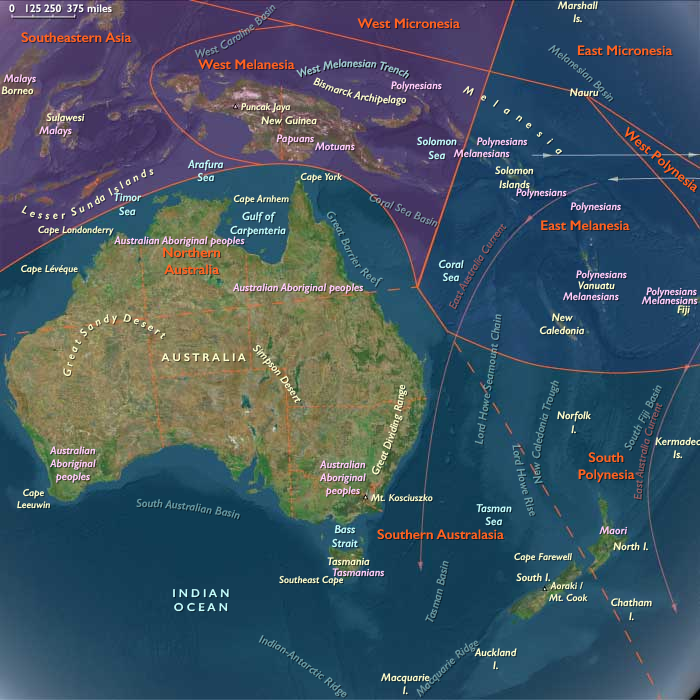
Australasia embraced contrasting worlds:
-
South Polynesia—Aotearoa (New Zealand’s North Island), the Chatham Islands, Norfolk, and the Kermadecs—formed the southern frontier of the Polynesian voyaging sphere.
-
Southern Australasia—the temperate regions of Australia and Tasmania along with the southern reaches of Aotearoa—combined coastal plains, forests, and grasslands shaped by fire and rain.
-
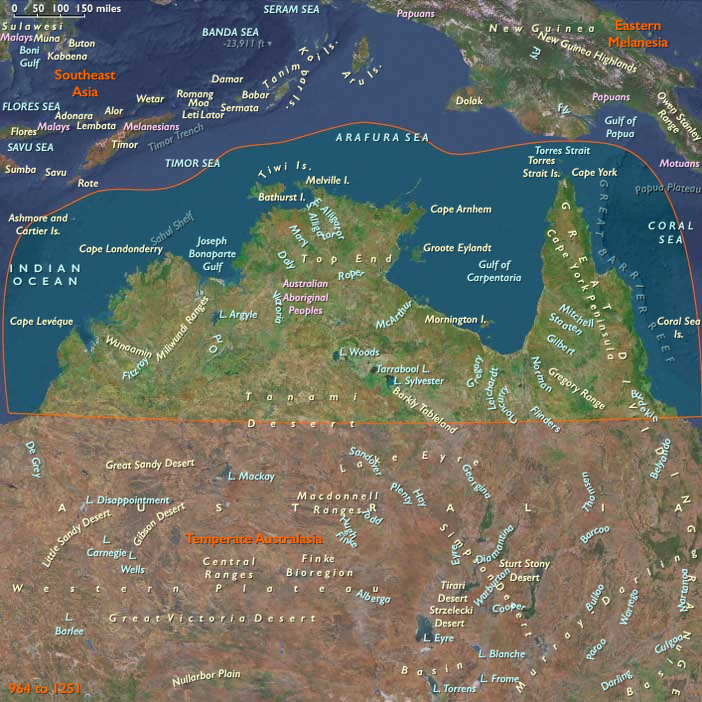
Northern Australia—the Kimberley, Arnhem Land, Cape York, and the Torres Strait—stood within the monsoon belt of tropical wetlands and savannas.
Together they formed a southern continent of immense ecological range—glacial fjords in the south, coral reefs in the north—bound by currents and migrations across the Indian and Pacific oceans.
Climate and Environmental Shifts
The Medieval Warm Period (≈ 950 – 1250 CE) brought mild, stable conditions throughout the southern latitudes.
In Aotearoa, temperate forests and fertile volcanic soils supported early horticulture.
In southern Australia, alternating wet and dry cycles guided fire-stick farming and forager mobility.
In the north, regular monsoons fed the wetlands of the Gulf and Cape York, while the Torres Strait reefs remained highly productive.
Overall, stable sea levels and predictable winds favored migration, trade, and biological richness across the region.
Societies and Political Developments
In Aotearoa, Māori ancestors expanded settlement across the North Island, forming tribal groups (iwi, hapū) grounded in ancestral descent. Chiefs (rangatira) exercised mana (sacred authority) through lineage and ritual. Horticultural villages spread along river valleys and coasts, while the first fortified villages (pā) emerged on strategic hills.
Far east in the Chatham Islands, settlers developed into the Moriori, a distinct people who adapted to cooler, forest-poor conditions by emphasizing marine resources over horticulture.
Norfolk and the Kermadecs supported smaller horticultural communities within the same voyaging tradition.
Across Australia, Aboriginal societies continued in long continuity. In the temperate south, clans maintained seasonal rounds between coast, river, and inland grassland; in the north, Arnhem Land and Kimberley bands organized around totemic songlines and ritual law.
In the Torres Strait, villages of volcanic islands grew into small chiefdoms. Horticulture (taro, yam, banana) and reef fishing supported populous communities that exchanged pearl shell, turtle shell, and ceremonial goods with Papua New Guinea and Cape York.
Economy and Exchange
Economic systems balanced horticulture, foraging, and trade.
-
In Aotearoa, kūmara (sweet potato), taro, and yam cultivation thrived under careful seasonal timing, supplemented by moa hunting, fishing, and forest harvest. Stone adzes, obsidian, and greenstone (pounamu) circulated through exchange networks.
-
In southern Australia, seasonal mobility enabled efficient resource use: eel and fish trapping, shellfish collecting, and grass-seed harvesting. Fire-stick farming maintained productive mosaics.
-
In northern Australia and the Torres Strait, taros and yams grew in garden plots alongside hunting and reef fishing. Pearl shell and dugong tusks served as prestige items in regional trade with Papua and Cape York.
Across the region, kin-based reciprocity replaced market exchange: goods and ritual obligations circulated through marriage alliances and ceremonial visits that bound societies together over vast distances.
Subsistence and Technology
Australasian technologies balanced innovation with tradition.
Māori developed storage pits to preserve kūmara through winter and earth ovens (hāngī) for cooking. Ocean-going waka (doubled-hulled canoes) enabled voyaging between Aotearoa’s islands and to outliers like the Chathams and Norfolk.
Aboriginal Australians perfected fish weirs, eel traps, and stone tool assemblages suited to local materials. Fire was a technological instrument for land care, reshaping ecosystems to enhance biodiversity.
In the Torres Strait, stone fish traps, outrigger canoes, and yam storage pits illustrated both innovation and continuity with Melanesian neighbors.
Movement and Interaction Corridors
Coastal and inland routes remained deeply embedded in cultural memory.
In Australia, songlines functioned as spiritual maps and trade paths, linking clans and ritual sites across hundreds of kilometers.
In Aotearoa, canoe travel along the coasts and river systems tied tribal communities together; the voyaging routes to Norfolk, Kermadec, and the Chatham Islands marked the outer limits of Polynesian navigation.
The Torres Strait remained a maritime crossroads, its islanders uniting Melanesian and Australian worlds through exchange and alliance.
Belief and Symbolism
Across Australasia, spirituality was inseparable from land and sea.
Aboriginal Dreaming mythologies explained the creation of landforms and codified laws of conduct, ensuring ecological stewardship through ritual and ceremony.
In Aotearoa, Māori cosmology centered on the separation of Rangi (Sky Father) and Papa (Earth Mother) and the ancestral power of mana and tapu.
Chatham Islanders retained Polynesian spiritual roots adapted to their cool, foraging world, invoking spirits of sea and bird.
In the Torres Strait, sky and sea spirits, fertility rituals, and ancestral masks embodied cosmic balance. Ceremonial dance and art unified social life and spiritual law from Arnhem Land to Cape York.
Adaptation and Resilience
Australasia’s strength lay in its flexibility.
-
Aboriginal societies balanced mobility and ceremony, their fire and foraging systems maintaining food security and biodiversity.
-
Māori communities transformed tropical Polynesian crops and rituals for temperate latitudes, combining horticulture with hunting and storage.
-
Torres Strait chiefdoms wove together horticulture, fishing, and trade to withstand climatic variability.
Reciprocity and ritual law anchored social resilience across this southern world of movement and memory.
Long-Term Significance
By 1251 CE, Australasia had reached a remarkable equilibrium between ancient continuity and new adaptation.
-
In Aotearoa, Māori ancestors established the social and ritual foundations that would define the next centuries.
-
In the Chatham Islands, the Moriori demonstrated ecological resilience in a harsh climate.
-
Across Australia, Aboriginal cultures maintained the longest unbroken relationship with land on Earth.
-
And in the Torres Strait, chiefly polities and trade routes bound Melanesia and Australia into one maritime system.
The southern continent thus stood at once ancient and innovative—its peoples living within ecologies they had long mastered and continuing to reshape them through ritual, mobility, and imagination.
Subjects
Regions