Maritime South Asia (1540–1683 CE): Vijayanagara’s Fall,…
1540 CE to 1683 CE
Maritime South Asia (1540–1683 CE): Vijayanagara’s Fall, Portuguese Hegemony, and Island Resilience
Geographic & Environmental Context
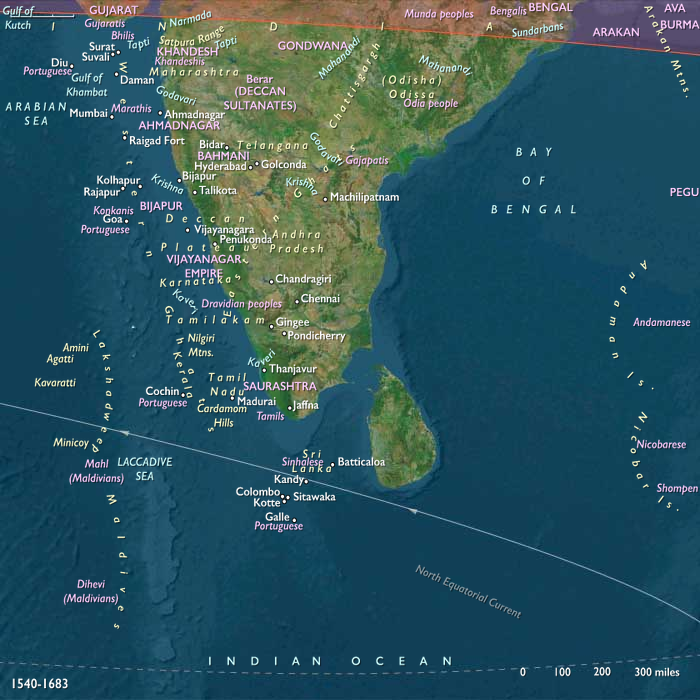
The subregion of Maritime South Asia includes southern India, Sri Lanka, the Maldives, Lakshadweep, Diego Garcia, and the Chagos Archipelago. Anchors included the Deccan plateau and river valleys of the Krishna, Tungabhadra, and Kaveri, the Coromandel and Malabar coasts, the central highlands and dry plains of Sri Lanka, and the coral atolls of the Maldives, Lakshadweep, and Chagos. This region, bridging fertile river valleys and spice-rich coasts with fragile island ecosystems, was drawn ever more deeply into global oceanic trade by Portuguese dominance.
Climate & Environmental Shifts
The Little Ice Age continued to bring climatic variability. In the Deccan, drought episodes alternated with heavy monsoons, stressing tanks and canals. On the Coromandel, unpredictable rains tested rice harvests. Sri Lanka’s dry zone suffered irrigation collapse in some districts, while cinnamon-rich coasts remained fertile. The Maldives, Lakshadweep, and Chagos endured monsoon shifts and occasional cyclones, but flexible fishing and coconut economies buffered shocks.
Subsistence & Settlement
-
Southern India: After the Battle of Talikota (1565), Vijayanagara collapsed; successor Nayaka states controlled Tamil and Telugu regions. Rice, millet, pulses, and cash crops like cotton and indigo sustained agrarian systems.
-
Malabar coast: Pepper gardens thrived under Portuguese and local patronage, but trade monopolies caused conflict.
-
Sri Lanka: Kotte splintered; Kandy rose in the central highlands, resisting Portuguese pressure. Rice paddies, coconut groves, and cinnamon exports anchored settlement.
-
Maldives: Atoll communities lived by fishing, coconuts, and small gardens; cowries remained a key export.
-
Lakshadweep: Villages combined coconuts, millet, and fishing, linked to Kerala ports.
-
Chagos (including Diego Garcia): Remained uninhabited but noted in Portuguese navigational records as remote provisioning points.
Technology & Material Culture
Portuguese introduced forts, cannon, and churches to Malabar and Sri Lanka. Shipyards produced dhows and European-style caravels. Nayaka courts patronized temples, murals, and bronze works. In Sri Lanka, Buddhist monasteries and Hindu shrines persisted, while Portuguese built Catholic chapels. Maldivians refined coir rope and outrigger canoes; islanders crafted mats and lacquered wood. Chagos reefs and atolls remained ecologically intact, visited only by passing ships.
Movement & Interaction Corridors
-
Portuguese Estado da Índia: Goa became the headquarters of imperial control. Fortresses at Cochin, Colombo, and along the Malabar coast enforced monopolies on pepper, cinnamon, and horses.
-
Trade routes: The Maldives exported cowries, tuna, and coir rope to India and East Africa. Lakshadweep linked Kerala to island provisioning.
-
Sri Lanka: Cinnamon exports tied the island to Lisbon’s markets, while Kandy sought inland autonomy.
-
Chagos: Though uninhabited, figured in navigational charts and occasional stopovers.
-
Dutch entry: By the 1640s, the Dutch East India Company (VOC) contested Portuguese strongholds, allying with Kandy to oust the Portuguese from much of Sri Lanka by 1658.
Cultural & Symbolic Expressions
-
Nayaka states: Patronized Hindu temples, Telugu and Tamil literature, and dance traditions.
-
Sri Lanka: Buddhist rituals in Kandy blended with royal statecraft; Portuguese Catholic missions converted lowland groups and elites in Colombo.
-
Maldives and Lakshadweep: Islamic devotion structured island life; Friday mosques in coral stone, Arabic-script chronicles, and Sufi practices tied them to the Indian Ocean Muslim world.
-
Chagos: Remained symbolically peripheral, remembered in sailors’ lore.
Environmental Adaptation & Resilience
Southern farmers relied on tank irrigation and canal systems to buffer droughts. Pepper, cotton, and indigo diversified cash income. In Sri Lanka, cinnamon and coconuts sustained export and subsistence. Islanders in Maldives and Lakshadweep combined coconuts, fishing, and cowries for resilience. Chagos remained an untouched ecological reserve.
Technology & Power Shifts (Conflict Dynamics)
-
Vijayanagara: Collapsed after Talikota; Nayaka rulers and Deccan sultanates restructured southern India’s politics.
-
Portuguese: Exercised naval dominance in Malabar and Sri Lanka, but provoked resistance.
-
Dutch: Emerged as serious rivals by mid-17th century, capturing Malacca (1641) and Sri Lankan forts (1658).
-
Sri Lanka: Kandy leveraged Dutch alliances to resist Portuguese encirclement.
-
Maldives: Endured Portuguese raids in the 16th century but repelled permanent occupation.
-
Chagos: Strategically mapped but politically marginal.
Transition
By 1683 CE, Maritime South Asia was transformed: Vijayanagara had fallen; Nayaka states and Deccan sultanates ruled the interior. Portuguese dominance waned under Dutch challenge. Sri Lanka was divided: Kandy independent inland, the Dutch rising on the coasts. The Maldives and Lakshadweep retained autonomy under Islamic rulers. Chagos remained uninhabited but increasingly charted. The age closed with shifting imperial balances, as the Dutch replaced the Portuguese across much of the Indian Ocean.
Images

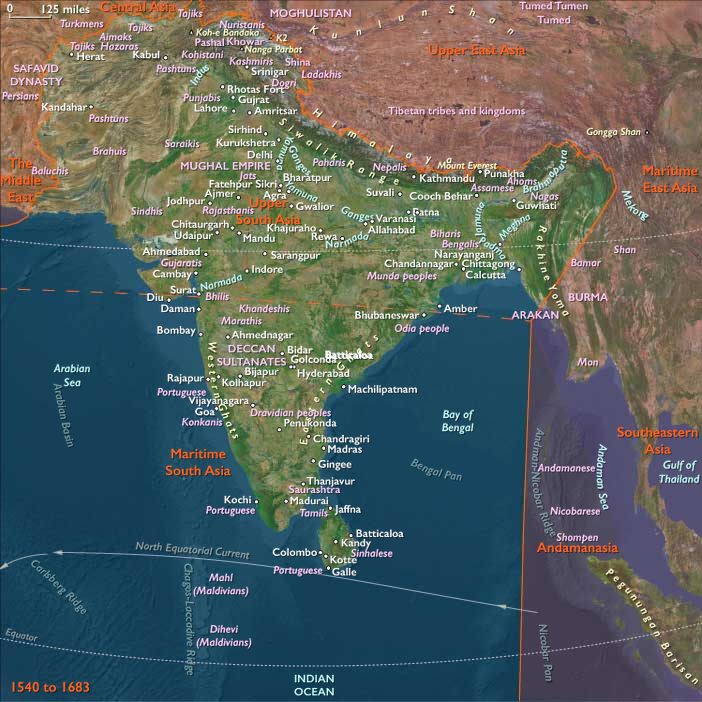
Southern South Asia (with civilization) ©2024-25 Electric Prism, Inc.
Groups
Commodities
Subjects
Regions
South Asia
View →Subregions