Maritime South Asia (1828–1971 CE): British Supremacy,…
1828 CE to 1971 CE
Maritime South Asia (1828–1971 CE): British Supremacy, Island Protectorates, and the Path to Independence
Geographic & Environmental Context
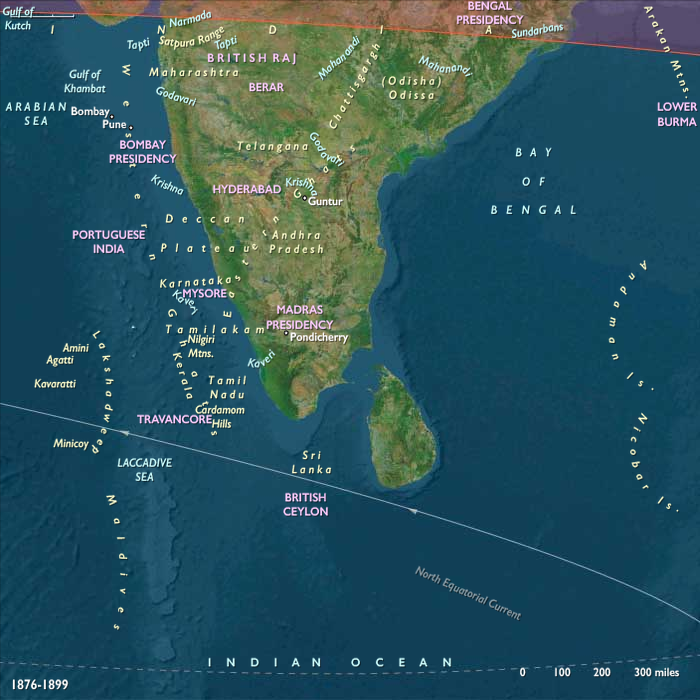
The subregion of Maritime South Asia includes southern India, Sri Lanka, the Maldives, Lakshadweep, Diego Garcia, and the Chagos Archipelago. Anchors included the Coromandel and Malabar coasts, the Deccan plateau river valleys of the Krishna, Tungabhadra, and Kaveri, the highlands and dry plains of Sri Lanka, and the coral atolls of the Maldives, Lakshadweep, and Chagos. During this period, British rule consolidated across peninsular India and Sri Lanka, while the smaller island groups were absorbed into imperial systems and later became strategic Cold War outposts.
Climate & Environmental Shifts
The 19th century saw recurring droughts and famines across the Deccan (notably the Great Famine of 1876–1878), linked to monsoon failures. Irrigation projects partly offset these crises. Sri Lanka’s plantations altered landscapes, clearing forest for tea and rubber. The Maldives and Lakshadweep remained dependent on monsoon rhythms for fishing and coconut harvests; cyclones periodically devastated atolls. The Chagos, converted to plantations, altered atoll ecologies through coconut monoculture.
Subsistence & Settlement
-
Southern India: British Madras Presidency integrated rice, millet, cotton, and indigo production into export frameworks. Railways tied hinterlands to coastal ports like Madras, Cochin, and Calicut.
-
Sri Lanka (Ceylon): After the fall of Kandy (1815), Britain controlled the whole island. Coffee plantations boomed mid-century, later replaced by tea and rubber. Rice remained a staple in villages, but plantation economies transformed upland life.
-
Maldives: Depended on coconuts, reef fishing, and rice imports; dried tuna and cowries circulated as exports. By the late 19th century, the islands became a British protectorate (1887).
-
Lakshadweep: Subsistence coconut and millet agriculture, with fishing and coir rope exports, tied the islands to Kerala’s economy.
-
Chagos (including Diego Garcia): Populated by enslaved Africans and indentured workers from Madagascar, Mozambique, and India, producing copra and coconut oil on French, later British plantations.
Technology & Material Culture
British forts, railways, and ports restructured southern India and Sri Lanka. Textile workshops declined under colonial imports, but handlooms persisted in villages. Plantation infrastructure (factories, warehouses) dotted Sri Lanka’s uplands. Maldivians crafted dhonis, coir rope, and lacquered boxes. Lakshadweep villagers built coral mosques and produced mats. In Chagos, plantation gear—copra dryers, presses, and storehouses—dominated material life. Radios, printing presses, and schools spread unevenly in the 20th century.
Movement & Interaction Corridors
-
Southern India: Rice, cotton, coffee, and indigo flowed from Deccan fields to Madras and Cochin ports, linking directly to Britain.
-
Sri Lanka: Tea, rubber, and cinnamon exported globally; Tamil laborers migrated from India under indenture contracts.
-
Maldives: Exports of cowries and fish reached Ceylon and Malabar; steamship lines connected Malé to Colombo.
-
Lakshadweep: Maintained strong maritime links to Kerala and Bombay.
-
Chagos: Functioned as plantation archipelago under Mauritius; later became strategically important. In the late 1960s, the UK created the British Indian Ocean Territory (BIOT) and displaced the Chagossians to Mauritius and Seychelles, paving the way for a joint US–UK base on Diego Garcia.
Cultural & Symbolic Expressions
-
Southern India: Hindu temples and Muslim mosques continued as cultural hubs; Christian missions expanded schools. Indian nationalist movements (Congress, Dravidian movements) flourished in the south.
-
Sri Lanka: Buddhist revival movements, Hindu reforms, and Christian missions shaped religious life. Independence movements emerged in the 20th century.
-
Maldives: Islam remained central; coral mosques, Arabic-script chronicles, and Quranic schools preserved identity.
-
Lakshadweep: Islamic devotion blended with maritime culture.
-
Chagos: Creole culture, shaped by African, Malagasy, and South Indian roots, endured on plantations until forced displacement in the 1960s.
Environmental Adaptation & Resilience
Farmers diversified rice, millet, and cash crops; irrigation canals and British-built dams stabilized harvests. Sri Lankan villagers relied on coconut, rice, and chena (shifting cultivation) alongside plantation employment. Islanders in the Maldives and Lakshadweep combined coconut, coir, and tuna fishing to withstand drought. Chagossians adapted copra production with fishing and garden plots, maintaining kinship and ritual life despite isolation.
Technology & Power Shifts (Conflict Dynamics)
-
Southern India: British consolidated Madras Presidency; anti-colonial resistance erupted in peasant uprisings and later nationalist movements.
-
Sri Lanka: Entirely under British rule until independence in 1948. Plantation strikes and nationalist agitation challenged colonial control.
-
Maldives: Retained Islamic sultanate under British protection (1887–1965); independence declared in 1965.
-
Lakshadweep: Integrated into British India, later into independent India after 1947.
-
Chagos: Under British Mauritius until 1965, when detached to form BIOT. The forcible removal of the Chagossians (1968–1973) was a major rupture, marking the islands’ conversion into a Cold War base.
Transition
By 1971 CE, Maritime South Asia was divided between new nation-states and lingering colonial structures. Southern India was part of independent India; Sri Lanka had gained independence in 1948; the Maldives was an independent republic (1965); Lakshadweep was integrated into India; the Chagos Archipelago had been emptied of its native population for the Diego Garcia base. The region’s ancient agrarian and maritime systems endured, but they had been radically reshaped by colonialism, plantation economies, and geopolitical transformations on the eve of the modern era.
Images

Southern South Asia (with civilization) ©2024-25 Electric Prism, Inc.
Groups
Commodities
Subjects
Regions
South Asia
View →Subregions