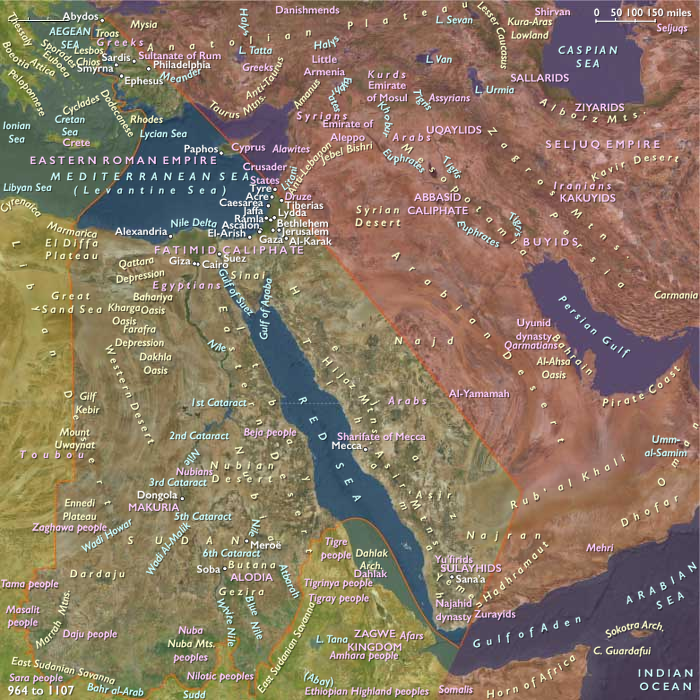
The Crusaders have arrived to an arid…
June 1099 CE
The Crusaders have arrived to an arid countryside, lacking in water or food supplies.
Here there is no prospect of relief, even as they fear an imminent attack by the local Fatimid rulers.
There is no hope of trying to blockade the city as they had at Antioch; the crusaders have insufficient troops, supplies, and time.
Rather, they resolve to take the city by assault.
They might have been left with little choice, as by the time the Crusader army reaches Jerusalem, it has been estimated that only about twelve thousand healthy foot-soldiers including fifteen hundred cavalry remain.
These contingents, composed of men with differing origins and varying allegiances, are also approaching another low ebb in their camaraderie; e.g., while Godfrey and Tancred make camp to the north of the city, Raymond makes his to the south.
In addition, the Provençal contingent does not take part in the initial assault on June 13, an action that is perhaps more speculative than determined, and after scaling the outer wall the Crusaders are repulsed from the inner one.
Without water or food, both men and animals will quickly die of thirst and starvation and the crusaders know time is not on their side.
People
Groups
Commodities
Subjects
Regions
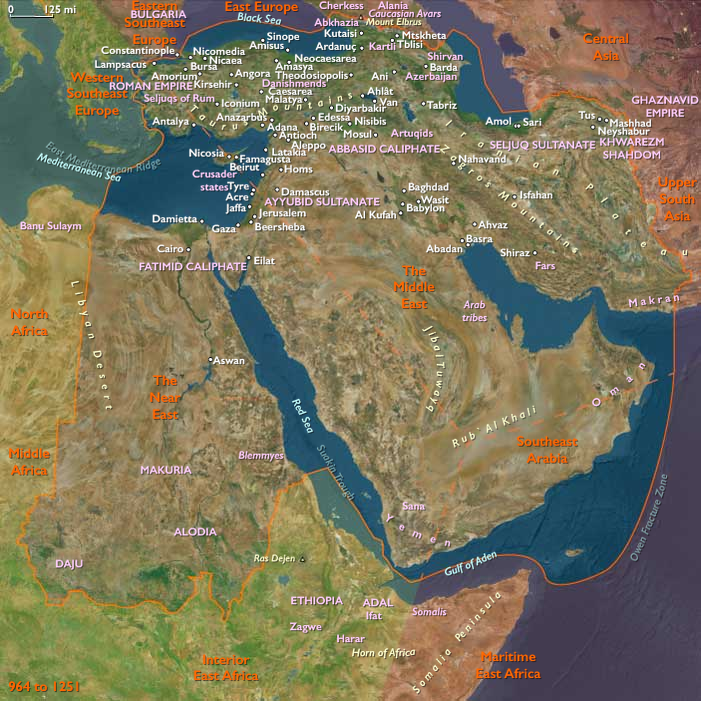
The Near and Middle East
View →Subregions