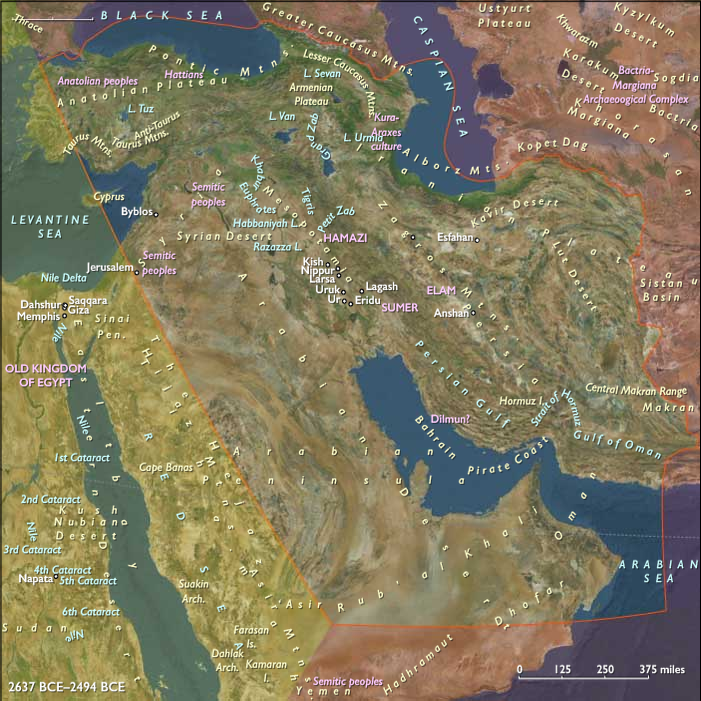
The Middle East (2637–2494 BCE): Historical Kingship,…
2637 BCE to 2494 BCE
The Middle East (2637–2494 BCE): Historical Kingship, Cultural Integration, and Urban Prosperity
Emergence of Historical Figures and Early Dynasties
Between 2637 and 2494 BCE, Mesopotamia witnessed the emergence of its earliest historical figure, Enmebaragesi of Kish, whose reign is documented in the Sumerian King List. Renowned for subduing Elam, Enmebaragesi became a pivotal figure in early Mesopotamian history, establishing the foundation for dynastic continuity. His son, Agga, would later become notable for his rivalry with Gilgamesh of Uruk, illustrating complex inter-city dynamics and political competition.
Sumerian and Akkadian Cultural Symbiosis
During this period, the Sumerian and Akkadian peoples cultivated a significant cultural symbiosis, exemplified by extensive bilingualism and linguistic convergence known as a sprachbund. The Akkadian language, utilizing the Sumerian-derived cuneiform script, first emerged clearly in written form around this time, marking an important linguistic and cultural milestone. Akkad, the influential city that lent its name to this Semitic language, became a prominent center of Mesopotamian civilization.
Religious and Mythological Developments
The era was characterized by significant religious and mythological transformations. Initially representing cosmic forces, Sumerian deities such as Enki and Inanna evolved into anthropomorphic "city gods," associated with political and urban identities. Their roles were defined by a hierarchical system headed by An and Enlil, reflecting and reinforcing sociopolitical structures within city-states.
Urban and Administrative Complexity
Southern Mesopotamia became densely populated with independent city-states centered around temples, often protected by oval boundary walls known as temple ovals. The urban landscape incorporated both religious complexes and secular structures such as palaces, illustrating administrative complexity and socio-political stratification.
Economic Growth and Metallurgical Innovations
Economic activity flourished, driven by advances in agriculture, metallurgy, and trade. Ur emerged as one of the richest cities in Sumer, notable for its sophisticated bronze metallurgy by 2500 BCE. Elaborate funerary practices at Ur's Royal Tombs, dating around 2600 BCE, showcased the city’s extraordinary wealth through lavish grave goods, including gold, silver, bronze artifacts, and meticulously crafted jewelry.
Elamite Kingdom and Cultural Exchange
The kingdom of Elam established itself firmly during the Old Elamite period, with its capital at Susa. Although the Elamite language was distinctively non-Iranian and possibly related to Elamo-Dravidian, Elam became deeply influenced by Mesopotamian culture, including significant linguistic borrowing and administrative structures. The matriarchal succession practices of Elam, where the throne passed through the female line, set it apart culturally from its neighbors.
Phoenician Maritime and Economic Expansion
Phoenician cities such as Byblos (Gubla), Tyre, and Sidon further solidified their roles as key maritime and trading hubs, actively engaging with Egypt and other Mediterranean and Near Eastern civilizations. Byblos, in particular, played a critical role, exporting timber, olive oil, and wine, and importing luxury items from Egypt, highlighting extensive commercial networks.
Technological and Scientific Advancements
Technological innovation was notable in advancements such as improved irrigation systems essential for agriculture and sophisticated brick technology that enabled monumental architecture like the famous ziggurats. Sumerians contributed significantly to early science and mathematics, developing a sexagesimal numerical system crucial to astronomy and temporal measurement.
Literary and Intellectual Heritage
This period also marked the preservation of key literary and intellectual traditions. The Epic of Gilgamesh, capturing profound existential themes, exemplified Sumerian literary sophistication and emotional depth. This epic served as a cultural and intellectual cornerstone, influencing subsequent Near Eastern and Mediterranean civilizations.
The age from 2637 to 2494 BCE thus represents a critical phase in Middle Eastern history, defined by the emergence of historical rulers, intensive cultural integration, economic prosperity, and substantial innovations that shaped the trajectory of ancient civilizations.
Groups
Commodities
Subjects
Regions
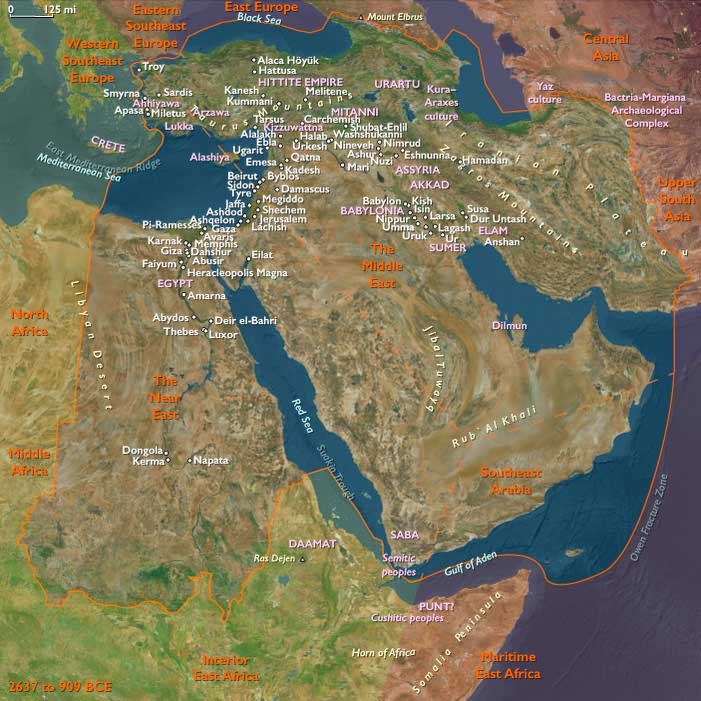
The Near and Middle East
View →Subregions