
Atlantic Southwest Europe (100–243 CE): Provincial Stability,…
100 CE to 243 CE
Atlantic Southwest Europe (100–243 CE): Provincial Stability, Civic Integration, and Cultural Adaptation
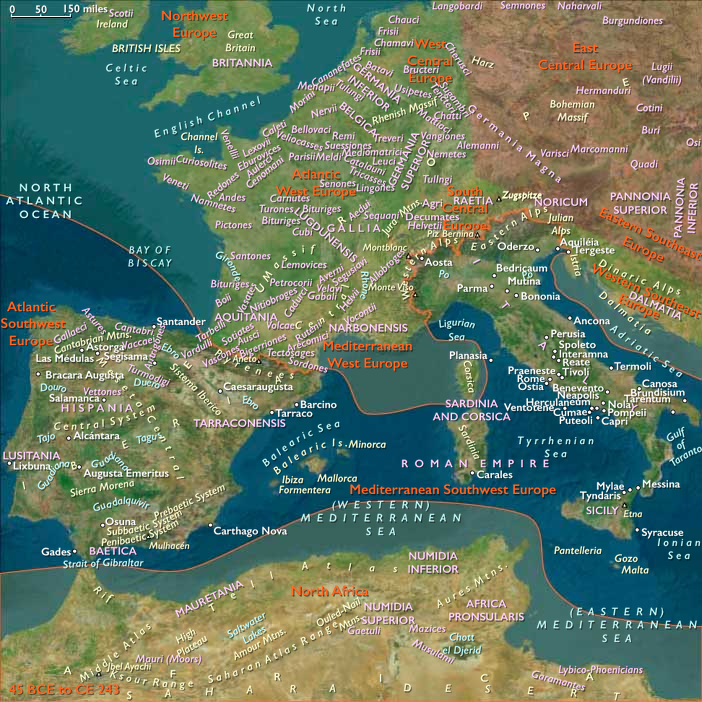
From 100 to 243 CE, Atlantic Southwest Europe—encompassing northern and central Portugal, Galicia, Asturias, Cantabria, and northern Spain south of the Franco-Spanish border (43.05548° N, 1.22924° W)—experienced remarkable stability, sustained economic prosperity, and deepening cultural integration within the Roman Empire. This age spanned the prosperous reigns of Emperors Trajan, Hadrian, Antoninus Pius, Marcus Aurelius, the Severan dynasty, and extended into the early years of Rome’s Crisis of the Third Century. It was defined by increasingly effective provincial administration, significant economic integration, expansion of Roman citizenship, and resilient local cultural identities.
Political and Military Developments
Throughout this period, Atlantic Southwest Europe remained notably stable and effectively governed, largely insulated from broader imperial turbulence. Early decades, particularly under Trajan and Hadrian, saw peak administrative efficiency, extensive civic investment, and flourishing urbanization. Provincial governance, maintained by permanent military garrisons, fortified urban centers, and robust infrastructure, provided sustained internal peace and effective administrative continuity.
Local civic elites progressively integrated into Roman administrative structures, playing critical roles in regional governance, especially following Caracalla’s landmark Constitutio Antoniniana (212 CE), granting universal Roman citizenship. Despite later imperial instability under Commodus and subsequent Severan rulers, the region’s well-developed administrative institutions ensured continued stability.
Economic and Technological Developments
Economic prosperity and integration into Mediterranean trade networks characterized the entire age. Regional exports—precious metals (silver, copper, tin), agricultural products, timber, salt, textiles, livestock, and slaves—flourished consistently, matched by imports of luxury items, fine ceramics, wine, olive oil, and sophisticated metal goods.
Slavery persisted as a foundational economic institution throughout this era, essential in mining, agriculture, artisanal production, domestic service, and urban construction. The active slave trade further embedded slavery within regional social and economic hierarchies.
Infrastructure investments, notably roads, aqueducts, public buildings, temples, amphitheaters, bridges, and ports, significantly enhanced connectivity, economic efficiency, and urban amenities. Technological advancements, especially in metallurgy, agriculture, and construction, consistently improved productivity, urban living standards, and regional prosperity.
Cultural and Religious Developments
Local cultures remained vibrant and resilient, creatively blending indigenous Iberian, Celtic, and Roman traditions. Material culture—including intricate metalwork, jewelry, fine pottery, ceremonial artifacts, and household objects—reflected dynamic cultural synthesis, maturity, and regional identities.
Religious and ritual traditions persisted actively, integrating indigenous Iberian and Celtic beliefs with Roman practices. Sacred landscapes, temples, communal ceremonies, traditional ancestral rites, warrior rituals, and regional festivals reinforced cultural cohesion, social solidarity, and tribal identities.
Expansion and Consolidation of Roman Citizenship
A major defining shift was Caracalla’s Constitutio Antoniniana (212 CE), extending universal Roman citizenship to all free inhabitants. This profoundly reshaped local civic identities, officially eroding formal tribal distinctions. However, while administrative recognition of tribal identities faded, strong local and cultural traditions continued informally, particularly in rural areas.
Notable Tribal Groups and Settlements
-
Lusitanians: Economically vibrant, culturally dynamic, increasingly integrated into Roman provincial civic structures while preserving strong local identities.
-
Vettones and Vaccaei: Maintained local prosperity, autonomy, and cultural continuity through diplomatic cooperation and civic integration.
-
Gallaeci, Astures, Cantabri: Fully integrated provincially, economically prosperous, actively preserving indigenous identities and cultural traditions.
-
Vascones: Successfully preserved territorial autonomy, diplomatic neutrality, and cultural distinctiveness, demonstrating resilience throughout the entire period.
Long-Term Significance and Legacy
Between 100 and 243 CE, Atlantic Southwest Europe:
-
Enjoyed consistent provincial stability and effective governance, significantly influencing its long-term administrative and regional cohesion.
-
Achieved sustained economic prosperity through deep integration into Mediterranean trade networks, embedding slavery firmly within regional economic life.
-
Demonstrated resilient cultural vitality, dynamically integrating indigenous Iberian and Celtic identities within an increasingly cohesive Roman provincial framework.
-
Underwent transformative civic integration through the universal citizenship decree (212 CE), profoundly shaping regional identities and facilitating deeper social and cultural assimilation into the Roman world.
This extended age firmly established Atlantic Southwest Europe as a stable, prosperous, culturally resilient province, shaping enduring regional identities, civic frameworks, and social structures that would influence its historical evolution throughout subsequent centuries.
People
Groups
Commodities
Subjects
Regions
Southwest Europe
View →Subregions
