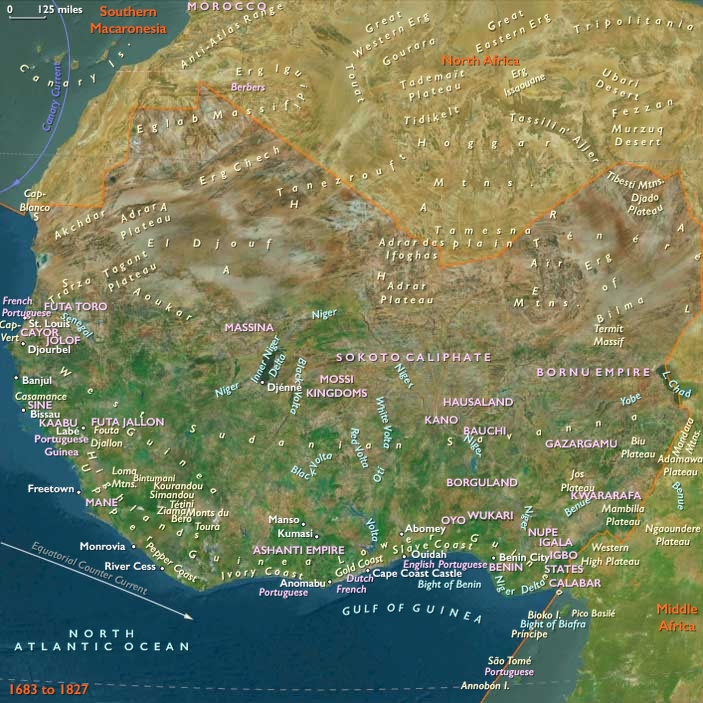
West Africa (1684–1827 CE): Zenith of the…
1684 CE to 1827 CE
West Africa (1684–1827 CE): Zenith of the Atlantic Trade, Inland Wars, and Early Abolition
Geographic & Environmental Context
The subregion of West Africa includes the Sahelian and savanna zones from the Senegal and Niger basins across modern Mali, Burkina Faso, and Niger, and the forest/coastal belts of Guinea, Sierra Leone, Liberia, Côte d’Ivoire, Ghana, Togo, Benin, and Nigeria. Anchors included the Niger Inland Delta, the savanna–forest transition, the Guinea lagoons, and the Atlantic forts and roadsteads from Senegambia to the Bight of Benin and the Bight of Biafra. Inland commercial axes linked the Niger bend to forest entrepôts; coastal factories tied the littoral to transoceanic markets.
Climate & Environmental Shifts
The later Little Ice Age brought irregular Sahelian rains, with drought pulses tightening pasture and river margins, followed by flood years that renewed floodplain rice fields in the Niger delta. Forest and coastal belts retained more stable rainfall but suffered storm surges in estuaries and lagoons. These swings shaped planting calendars, cattle transhumance, and the reliability of river routes.
Subsistence & Settlement
Rice, millet, sorghum, and floodplain rice sustained Sahelian and savanna towns; yams, plantains, oil palm, and kola supported dense forest villages. Coastal fisheries and mangrove saltworks complemented farming. Urban and courtly centers expanded around inland/sea trade: Asante consolidated the forest gold belt; Dahomey centralized around Abomey–Ouidah; Oyo projected cavalry power across the savanna to the coast. In the east, populous delta city-states (Bonny, Calabar) organized canoe-borne commerce; in the Sahel, scholarly towns endured under shifting military overlords and later the Sokoto Caliphate (from 1804–1808).
Technology & Material Culture
Iron-smelting and blacksmithing continued to supply hoes, swords, and spearheads, while imported muskets and powder reshaped warfare. Long river canoes and lagoon fleets ferried bulk goods; head-portage and caravan trains linked forest to Sahel. Courts commissioned brass and ivory regalia (Benin, Owo), gold ornaments (Asante), adire and strip-woven textiles, and richly appliquéd war flags. Shrines housed vodun, orisha, and Ifá paraphernalia; masked egungun and asafo standards dramatized ritual and martial identity.
Movement & Interaction Corridors
Caravan roads from Jenne–Timbuktu fed salt, kola, leather, and captives toward the forest and coast; the Niger River moved grain, fish, and scholars. On the Atlantic, European forts and factories—Dutch, English, Portuguese, French, Danish, Brandenburg—dotted Elmina–Cape Coast–Anomabu, Ouidah, Lagos–Badagry, Bonny, and Calabar. Coastal and inland slaving routes converged at these ports, structuring the Middle Passage. Late in the period, abolition currents re-routed flows: Britain’s ban (1807) and patrols began altering shipping, while Sierra Leone emerged as a settlement for recaptives; the American Colonization Society planted Liberia (from 1822).
Cultural & Symbolic Expressions
Islam framed Sahelian cities through Friday mosques, Qur’anic schools, and Sufi networks (Qadiriyya; later Tijaniyya), producing legal and historical manuscripts. In the forest and coast, ritual kingship and shrines ordered political life: vodun in Dahomey, orisha devotion in Yorubaland, Ifá divination, egungun masquerades, and Fante asafo companies. Court art (Benin bronzes; Asante goldwork; Kente/strip-weaves) signaled sovereignty and cosmology. Oral epics and praise poetry narrated wars, market wealth, and divine sanction.
Environmental Adaptation & Resilience
Households diversified fields (millet/rice with legumes), shifted plots across soil types, and leveraged wetlands and inland fisheries in lean years. Oil palm groves stabilized forest livelihoods; in Senegambia, groundnuts expanded as a drought-resilient cash food by the early 19th century. War and raiding spurred defensive relocation—moated towns, hilltop refuges, and dispersed hamlets—while coastal peoples leaned on fishing/salt in famine. Islamic zawiyas, guilds, and market associations redistributed grain; ritual fraternities mobilized labor and security.
Technology & Power Shifts (Conflict Dynamics)
Imported muskets and cavalry logistics (Oyo) enabled long-range raiding; Asante restructured tributary routes and gold/slave flows through forest corridors; Dahomey militarized with regiments including the Mino (women’s corps) and monopolized Ouidah’s trade. In the Sahel, Moroccan firearms had earlier unseated Songhai; by 1804–1808, Fulani-led jihads forged the Sokoto Caliphate, reorganizing taxation, courts, and markets across Hausaland. Firearms, horses, and coastal demand recursively amplified inland conflicts and captivity.
Transition
By 1684–1827 CE’s end, West Africa stood at a hinge. Coastal polities (Asante, Oyo, Dahomey; delta city-states) had integrated deeply into Atlantic commerce; inland jihads birthed the Sokoto Caliphate; the Benin kingdom’s coastal influence waned amid shifting routes. Abolition had begun to reconfigure seaborne slaving (Britain 1807; U.S. 1808), steering commerce toward “legitimate” exports—palm oil, ivory, kola, gum, groundnuts—without ending bondage inland. Intellectual and ritual networks remained robust; artistic courts still shone. Yet warfare, displacement, and the slave trade’s long tail scarred societies even as new corridors opened. The next age would pivot on abolition enforcement, palm-oil booms, missionary incursions, and the tightening coils of European imperial ambition.
Images

West Africa (with civilization) ©2024-25 Electric Prism, Inc. All rights reserved.
Groups
Topics
Commodities
Subjects
Regions

West Africa
View →Subregions