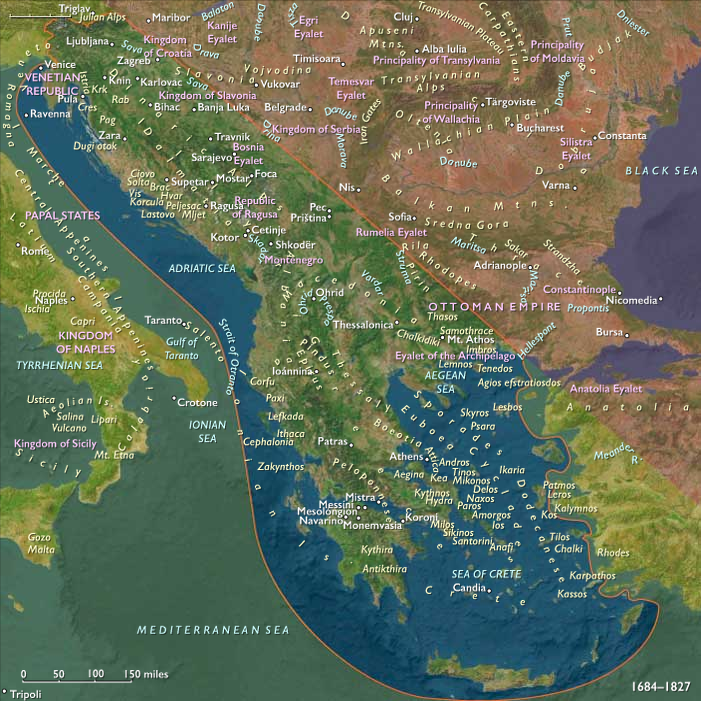
Western Southeast Europe (1684–1827 CE) Empires in…
1684 CE to 1827 CE
Western Southeast Europe (1684–1827 CE)
Empires in Retreat, Balkan Uprisings, and Coastal Gateways
Geography & Environmental Context
Western Southeast Europe includes Greece, Albania, Montenegro, North Macedonia, Kosovo, most of Bosnia and Herzegovina, southwestern Serbia, most of Croatia, and Slovenia. Anchors include the Dinaric Alps, the Pindus mountains, the Vardar/Axios, Neretva, and Drina valleys, the Dalmatian coast and Adriatic islands, the Peloponnese, Epirus, and the port cities of Athens, Thessaloniki, Dubrovnik, Split, Kotor, Tirana, Sarajevo, Skopje, Ljubljana, and Zagreb. The region’s rugged uplands, fertile valleys, and long coasts made it both a corridor and a frontier between empires.
Climate & Environmental Shifts
The Little Ice Age lingered into the early 19th century, producing cold winters, erratic rainfall, and shorter growing seasons in upland basins. Droughts and floods periodically devastated harvests, especially in the Vardar and Sava–Drina valleys. Earthquakes were frequent—most devastating in Ionian and Aegean islands. Malaria haunted lowland marshes, while mountain transhumance buffered food security.
Subsistence & Settlement
-
Agriculture:
-
Greece: Olives, vines, figs, and cereals in Attica and the Peloponnese; transhumant flocks in Epirus and Pindus; smallhold vines and citrus in Aegean islands.
-
Western Balkans: Mixed cereals (wheat, barley, maize), vineyards, tobacco (notably Macedonia), and pastoralism in Bosnia, Montenegro, and Kosovo.
-
Dalmatian coast: Limited arable land, reliance on vineyards, olives, and fishing.
-
-
Urban centers: Athens and Thessaloniki were provincial Ottoman hubs; Dubrovnik (Ragusa) remained a semi-independent merchant republic until 1808; Sarajevo, Skopje, and Tirana grew as Ottoman provincial centers; Ljubljana and Zagreb linked Habsburg lands to the Adriatic.
Technology & Material Culture
Agriculture relied on ox-drawn plows, terraces, and irrigation channels in Mediterranean valleys. Coastal towns built stone harbors, galleys, and small sailing vessels; Venetian, Ottoman, and later French naval forces dominated major routes. Everyday life was shaped by stone farmhouses, pottery, woven woolens, and Ottoman-influenced crafts in Sarajevo and Skopje. Fortresses crowned hilltops, while Orthodox monasteries and Catholic churches persisted across uplands and coasts.
Movement & Interaction Corridors
-
Imperial routes: The Ottoman Empire ruled most of the region, but the Habsburgs pushed south into Croatia, Slovenia, and parts of Bosnia after the Treaty of Karlowitz (1699).
-
Coastal gateways: Dubrovnik thrived as a diplomatic and trading hub until Napoleonic abolition; Venetian Dalmatia linked Adriatic ports to Mediterranean commerce.
-
Pilgrimage routes: Orthodox circuits to Mount Athos and Catholic shrines in Dalmatia and Slovenia sustained regional ties.
-
Revolts and wars: The Morean War (1684–1699) saw Venice briefly control the Peloponnese; repeated Russo-Turkish wars brought Russian fleets into the Aegean; the First Serbian Uprising (1804–1813) reverberated into the southwestern Balkans.
-
Napoleonic occupations: After 1797, Venice’s Dalmatian possessions fell to Austria, then to France (Illyrian Provinces, 1809–1814), briefly integrating the Adriatic coast into Napoleonic Europe.
Cultural & Symbolic Expressions
-
Religion: Orthodoxy dominated Greece, Macedonia, Montenegro, and Serbia; Catholicism shaped Dalmatia, Slovenia, and parts of Croatia; Islam spread in Bosnia, Kosovo, and Albanian lowlands. Religious pluralism defined the region’s contested identity.
-
Language and literature: Early stirrings of national revivals—Greek Enlightenment writings, Illyrian and Serbian literary awakenings, Albanian oral epics, and Slavic folk poetry—articulated cultural autonomy under Ottoman and Habsburg rule.
-
Architecture and arts: Ottoman mosques and baths in Sarajevo and Skopje coexisted with Venetian baroque in Dalmatian towns and Orthodox monasteries in Greece and Montenegro. Folk songs, dances, and epic recitations preserved communal memory of resistance and kinship.
Environmental Adaptation & Resilience
-
Terracing and irrigation: Maintained olives, vines, and citrus on marginal slopes.
-
Transhumance: Seasonal herding across mountain–valley gradients stabilized meat and dairy supply.
-
Diversification: Fishing, viticulture, and craft industries (wool, metalwork, leather) buffered agrarian risks.
-
Community resilience: Monasteries, village cooperatives, and guilds provided credit, relief, and social cohesion.
Political & Military Shocks
-
Ottoman decline: The empire struggled to control upland tribes and coastal cities, with frequent rebellions in Montenegro, Epirus, and Greece.
-
Venetian retreat: After Karlowitz (1699), Venice held only Dalmatia and Ionian Islands until Napoleon dissolved the Republic (1797).
-
Napoleonic Wars: French administration (Illyrian Provinces) introduced reforms and codes, while British naval power secured the Ionian Islands.
-
Greek War of Independence (1821–1829): Insurrection in the Peloponnese, Attica, and islands devastated Ottoman rule; international intervention by Britain, France, and Russia culminated in the decisive Battle of Navarino (1827), heralding an independent Greek state.
Transition
Between 1684 and 1827, Western Southeast Europe evolved from an Ottoman–Venetian borderland into a crucible of nationalist upheaval. Agricultural terraces, herding, and vineyards endured under imperial taxation and war, while coastal cities pivoted between Venetian, Ottoman, Habsburg, and French control. Cultural revivals—Greek Enlightenment, Illyrian and Serbian stirrings, Albanian epics—challenged imperial authority. By 1827, the Greek Revolution symbolized a larger unraveling: the age of Ottoman dominance was ending, and new national states were poised to emerge from centuries of contested frontier life.
Images

Western Southeast Europe (with civilization) ©2024-25 Electric Prism, Inc. All rights reserved.
Groups
Topics
Commodities
Subjects
Regions
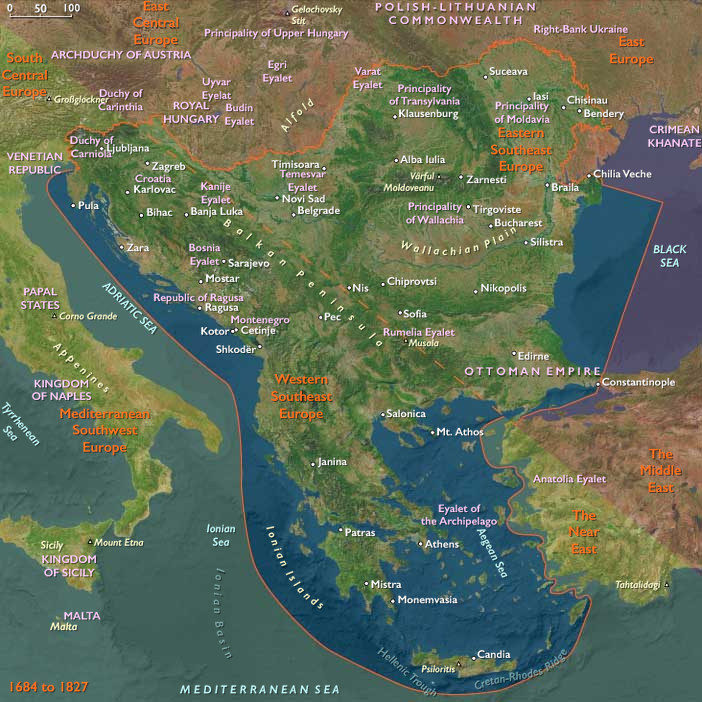
Southeast Europe
View →Subregions