
East Africa (964 – 1107 CE): Swahili …
Years: 964 - 1107
East Africa (964 – 1107 CE): Swahili Urbanization, Highland Monasteries, and Great Lakes Consolidation
Geographic and Environmental Context
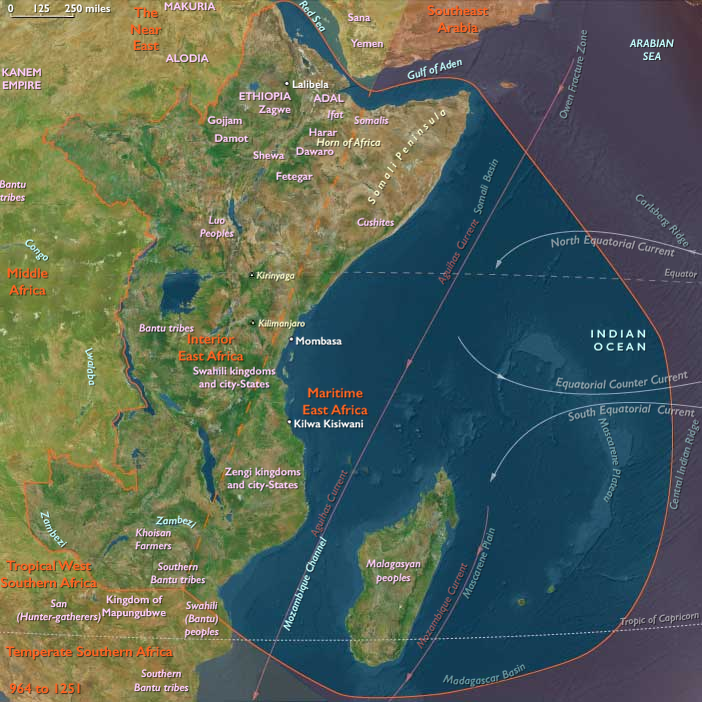
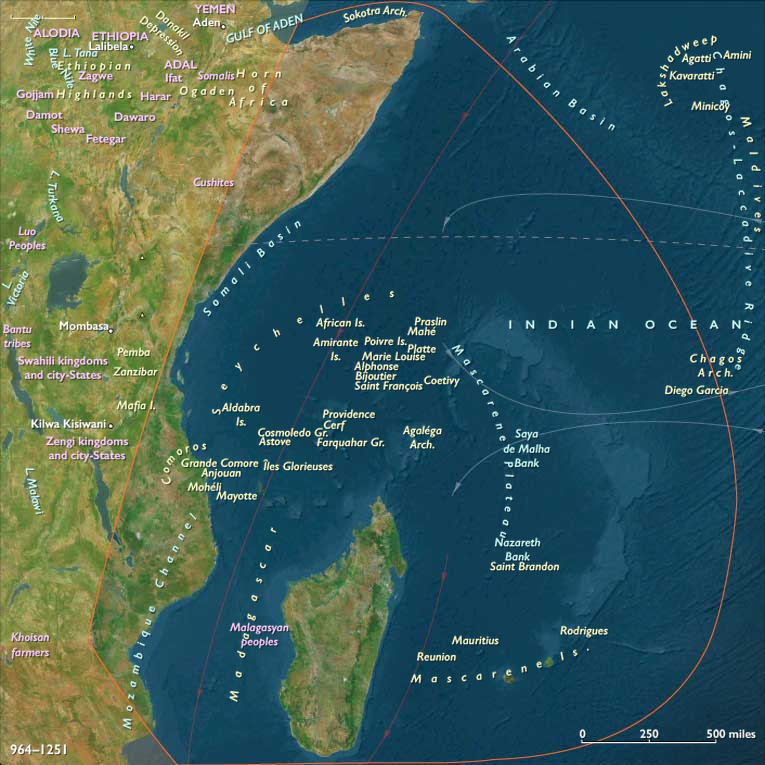
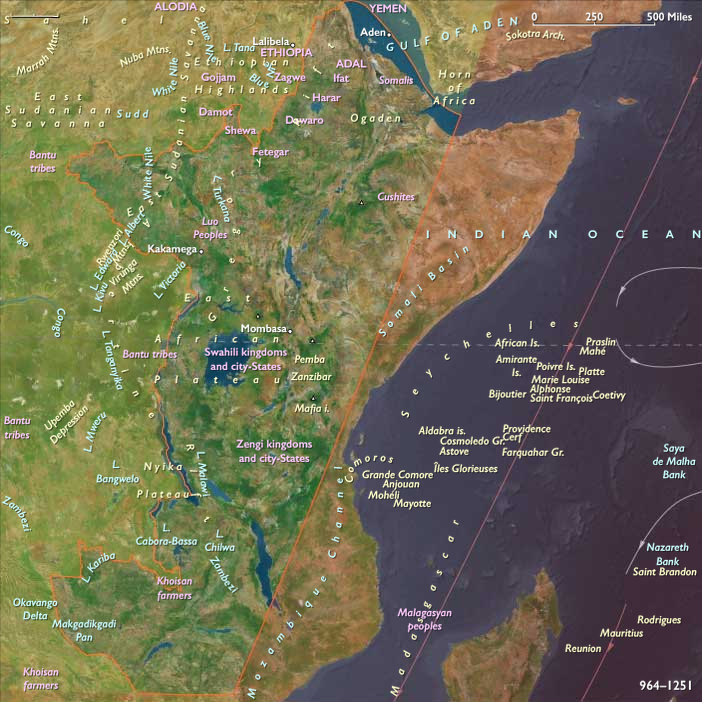
East Africa in this era stretched from the Red Sea and Indian Ocean coasts to the Ethiopian Highlands, Upper Nile, and Great Lakes region, encompassing Eritrea, Djibouti, Ethiopia, Sudan’s southern Nile valley, Uganda, Kenya, Tanzania, Rwanda, Burundi, northern Mozambique, Zambia, northern Zimbabwe, and Malawi.
The region united two complementary zones:
-
A maritime littoral, where Swahili city-states—Mombasa, Kilwa, Zanzibar, Pemba, and Mafia—emerged along the coral coast.
-
An interior corridor of highlands, lakes, and savannas, whose farming, herding, and monastic systems anchored inland exchange.
Together they formed a dynamic continuum between the Indian Ocean and Africa’s continental heartlands.
Climate and Environmental Shifts
The Medieval Warm Period (c. 950–1250) brought stable monsoons and generally favorable rainfall.
-
Indian Ocean trade winds ensured regular sailing seasons and consistent coastal agriculture.
-
Ethiopian Highlands enjoyed steady harvests of teff, barley, and ensete.
-
Great Lakes basins—Victoria, Tanganyika, and Malawi—supported intensive banana and yam cultivation.
-
Savannas and river valleys in Uganda, South Sudan, and Zambia alternated between wet and dry cycles, buffered by mobility and ecological diversity.
-
Madagascar’s eastern rainforests and western plains provided a dual ecology supporting both Austronesian–African farming and coastal cattle herding.
Societies and Political Developments
Swahili Coast and Islands
Between 964 and 1107, the Swahili littoral transformed into one of the world’s most cosmopolitan maritime zones.
-
Kilwa Kisiwani rose to prominence, extending its influence southward toward Sofala.
-
Mombasa, Pemba, Zanzibar, and Mafia evolved into urbanized stone-and-coral settlements, blending African, Arabian, and Persian elements.
-
Comoros islands deepened Islamic affiliation through contact with Hadrami and Omani merchants.
-
Madagascar’s coastal communities consolidated politically while highland societies developed terracing and irrigation, integrating Austronesian, African, and Islamic influences.
-
The Seychelles and Mascarenes remained uninhabited but intermittently sighted by sailors.
Ethiopian Highlands and Upper Nile
In the post-Aksumite highlands, authority fragmented among Christian regional dynasties in Tigray, Amhara, and Lasta (Agaw).
-
Monastic networks preserved Geʽez scripture, liturgy, and scholarship, maintaining continuity with ancient Aksum.
-
Churches and local dynasts organized around pilgrimage centers rather than a single monarchy—Zagwe unification would only arise after 1137.
Farther west, Nilotic cattle peoples—ancestors of Dinka, Nuer, and Shilluk—formed ritual chiefdoms, where cattle wealth structured social power and fertility rites.
Great Lakes and Southern Interior
In the Great Lakes region, Bantu-speaking communities expanded through banana horticulture, ironworking, and lacustrine fisheries, forming proto-kingdoms—the precursors of Buganda, Bunyoro, Rwanda, and Burundi.
These were organized through clan alliances and fortified hill centers, governed by sacral chiefs who mediated rain, harvest, and justice.
Southward, in Zambia, northern Zimbabwe, Malawi, and inland Mozambique, iron-smelting and copper production intensified.
Farming villages coalesced into chieftaincies trading copper, salt, and ivory northward—linked eventually to the gold-trading horizons of Great Zimbabwe.
Economy and Trade
Coastal–inland integration defined East Africa’s prosperity.
-
Swahili city-states exported ivory, gold, tortoiseshell, and slaves, importing Indian cottons, Chinese ceramics, Arabian horses, and Persian glassware.
-
Kilwa controlled the flow of southern gold from the hinterlands of Sofala and Zimbabwe.
-
Madagascar exchanged cattle, rice, and forest products for beads and cloth, acting as a provisioning base for merchants.
-
Ethiopian Highlands traded gold, ivory, and slaves toward the Red Sea via caravan routes through Aksumite successor towns.
-
Great Lakes corridors moved fish, bananas, and iron tools toward the coast; Zambezi–Copperbelt routes ferried copper and salt to Swahili and inland markets.
-
Monastic towns and caravan stations in the highlands linked local production to global Indian Ocean networks.
Subsistence and Technology
-
Highlands: terrace farming, plow cultivation, and ox traction; irrigation canals sustained cereals and ensete groves.
-
Great Lakes: banana gardens, yam plots, and intensive fishing supported dense populations.
-
Upper Nile and Savannas: transhumant cattle herding with ritualized mobility; kraals and lineage pastures served as wealth vaults.
-
Coast and islands: coral-stone architecture, dhows with lateen sails, and irrigation-fed gardens of coconuts, rice, and sugarcane.
-
Metallurgy: iron and copper smelting advanced inland production; copper ingots from Zambia were traded as prestige goods.
-
Navigation: mastery of monsoon sailing and reef-harbor construction allowed year-round maritime traffic between Arabia, India, and the African coast.
Movement and Interaction Corridors
-
Monsoon circuits: dhows plied seasonal routes between Kilwa, Aden, Gujarat, and Oman.
-
Highland–coastal routes: caravans carried ivory, gold, and slaves from Ethiopia and the Great Lakes to Mombasa and Kilwa.
-
Lakes and rivers: Victoria–Tanganyika–Malawi waterways supported canoe-based transport of food and tools.
-
Red Sea paths: pilgrims and merchants moved between Aksumite monasteries and Fatimid Cairo.
-
Southern interior tracks: Copperbelt–Zambezi–Sofala linked inland metallurgy to the Swahili coast.
Belief and Symbolism
-
Islam flourished along the Swahili littoral, reshaping urban architecture and literacy through mosques, minarets, and Arabic script.
-
In Madagascar, Austronesian–African syncretism persisted—ancestor veneration combined with rice rituals and emerging Islamic influence.
-
In the Ethiopian Highlands, Christianity endured through monasteries, saints’ cults, and Geʽez scripture, maintaining continuous liturgical traditions from Aksum.
-
Nilotic societies sacralized cattle; ritual chiefs personified rain and fertility.
-
Great Lakes clans fused ancestor worship and sacred kingship, viewing royal power as divine mediation of abundance.
Adaptation and Resilience
-
Ecological complementarity across highland, lake, and coastal zones ensured redundancy against climatic stress.
-
Monsoon regularity sustained trade and allowed surplus redistribution across wide distances.
-
Monasteries and clan federations preserved stability, law, and stored surpluses.
-
Technological innovation—iron plows, terrace agriculture, coral masonry—deepened productivity and specialization.
-
Cultural integration across the Indian Ocean and interior networks fostered resilience through diversity rather than uniformity.
Long-Term Significance
By 1107 CE, East Africa had matured into a dual system of urban coasts and organized interiors:
-
Swahili city-states flourished as Islamic maritime entrepôts, their mosques and markets standing as the first true cities of sub-Saharan Africa.
-
Madagascar and Comoros anchored the western Indian Ocean’s agrarian base.
-
Ethiopian Christian polities preserved sacred learning and commerce, foreshadowing the Zagwe dynasty.
-
Great Lakes proto-kingdoms and Nilotic cattle chiefdoms consolidated inland complexity.
-
Copper, salt, ivory, and gold bound the interior to the Swahili and Red Sea economies.
This age created the enduring framework of East African civilization—a world where monastery and mosque, lake and coast, ivory and incense together wove the region into the expanding Afro-Eurasian network of faith, trade, and culture.
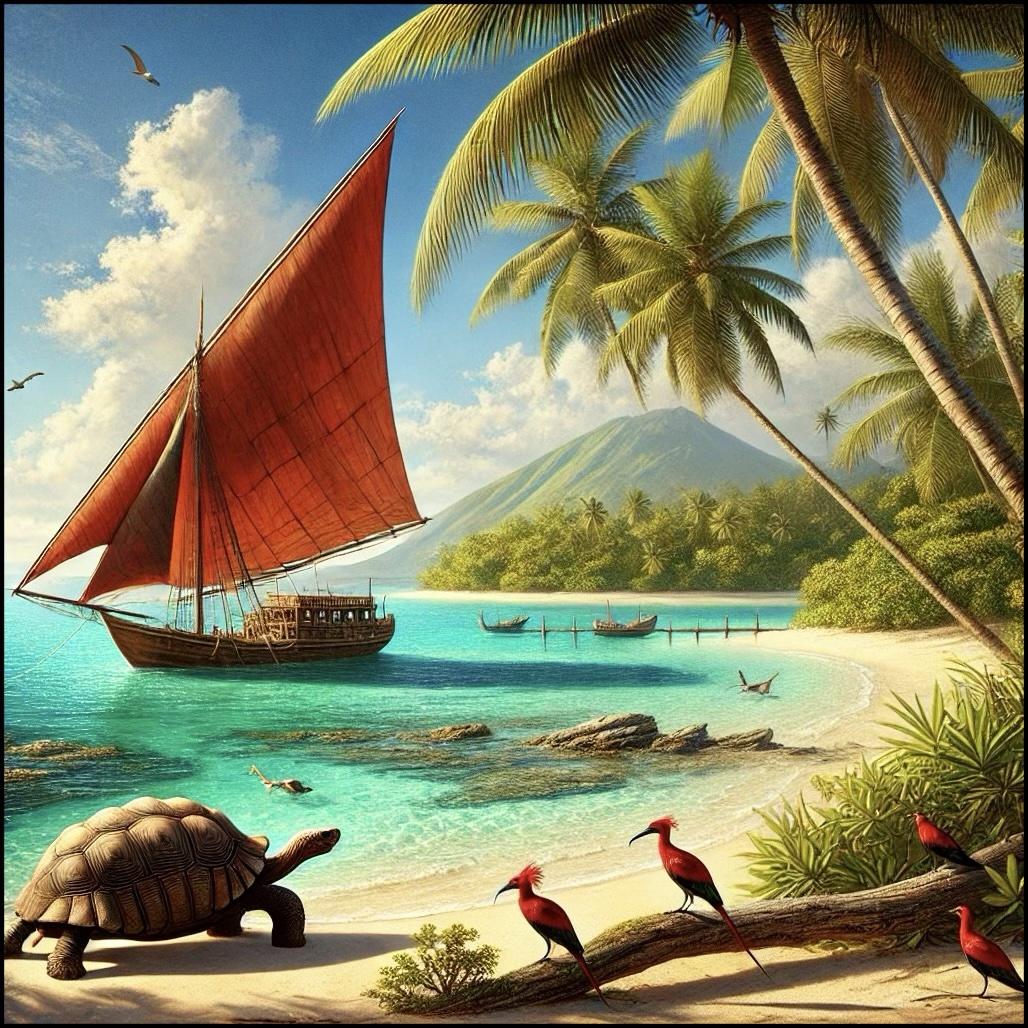
Maritime East Africa (with civilization) ©2024-25 Electric Prism, Inc. All rights reserved.
Groups
- Austronesian peoples
- Bantu peoples
- Arab people
- Omanis
- Somalis
- Nilotic peoples
- Swahili people
- Islam
- Oman, First Imamate of
- Malagasy peoples
- Abbasid Caliphate (Baghdad)
- Kilwa Sultanate
Commodoties
- Gem materials
- Glass
- Domestic animals
- Grains and produce
- Textiles
- Ceramics
- Strategic metals
- Slaves
- Lumber
- Money
- Aroma compounds
- Spices
Subjects
Regions
Subregions
Related Events
Showing 10 events out of 52798 total
Years: 964 - 1107
Maritime East Africa (with civilization) ©2024-25 Electric Prism, Inc. All rights reserved.
Groups
- Austronesian peoples
- Bantu peoples
- Arab people
- Omanis
- Somalis
- Nilotic peoples
- Swahili people
- Islam
- Oman, First Imamate of
- Malagasy peoples
- Abbasid Caliphate (Baghdad)
- Kilwa Sultanate
Commodoties
- Gem materials
- Glass
- Domestic animals
- Grains and produce
- Textiles
- Ceramics
- Strategic metals
- Slaves
- Lumber
- Money
- Aroma compounds
- Spices
Subjects
Regions
Subregions