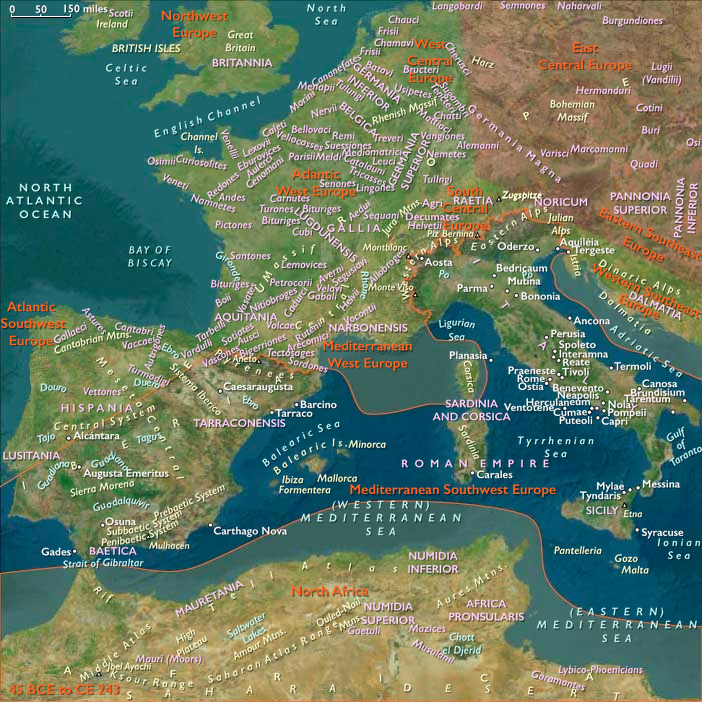
Mediterranean Southwest Europe (45 BCE–99 CE): From…
45 BCE to 99 CE
Mediterranean Southwest Europe (45 BCE–99 CE): From Republic's End to Imperial Stability
The age 45 BCE–99 CE in Mediterranean Southwest Europe—encompassing Italy, southern and eastern Iberia, Andorra, and all Western Mediterranean islands except Corsica—marks Rome's profound shift from a collapsing republic to a stabilized imperial power. This transformative era encompasses pivotal military confrontations, sweeping political reforms, expansive colonization, and influential cultural achievements.
Caesar’s Dictatorship and the Fall of the Republic (45–34 BCE)
This era begins with Julius Caesar's final victories and his controversial assumption of lifelong dictatorship, swiftly followed by his assassination in 44 BCE. The resulting power vacuum triggers intense political struggles, culminating in the formation of the Second Triumvirate. Antony and Octavian’s victory at Philippi extinguishes the republican cause, setting the stage for imperial governance. Over subsequent centuries, Rome will expand into a vast empire stretching from Britain to Persia, blending Greek, Roman, and other cultures into a unique civilization.
Augustus's Rise and Rome’s Imperial Establishment (33–22 BCE)
After Antony and Cleopatra's decisive defeat at Actium in 31 BCE, Octavian, soon titled Augustus, establishes undisputed imperial authority. His principate initiates the Pax Romana, an era of remarkable peace and prosperity. Augustus implements significant administrative reforms and fosters provincial integration, fundamentally transforming Roman governance. His reign is later celebrated as a golden age.
Urban Expansion and Foundation of Caesaraugusta (21–10 BCE)
Strategically reinforcing Rome’s dominance, Augustus founds veteran colonies, notably Caesaraugusta (modern Zaragoza) in Iberia, around 25–12 BCE. Romanization rapidly progresses, with Hispania divided into multiple separately governed provinces. Iberian elites and urban oligarchs become integrated into Roman aristocracy, actively participating in imperial governance.
Augustan Reforms and the Pax Romana (9 BCE–3 CE)
Augustus deepens administrative and infrastructural consolidation, reinforcing Roman cultural identity and political cohesion. His reforms bolster economic prosperity and stability, establishing foundational precedents for imperial administration. Iberia, called Hispania, flourishes economically, exporting goods such as gold, wool, olive oil, and wine, becoming a crucial granary alongside North Africa.
Cultural Achievements and International Diplomacy (4–15 CE)
This period is marked by major literary achievements, notably Ovid’s Metamorphoses, alongside critical debates regarding luxury imports such as silk. Diplomatic interactions, possibly including envoys from China, illustrate Rome's expansive geopolitical influence.
Stability and Challenges under Tiberius (16–27 CE)
Augustus’s successor, Tiberius, initially maintains stability but increasingly isolates himself from public and senatorial life, inadvertently fostering political anxiety. Despite growing unease, the empire's administrative and economic systems remain robust.
Political Instability and Caligula’s Reign (28–39 CE)
Tiberius’s reclusiveness exacerbates political tensions, resulting in Caligula’s tumultuous ascension. Initially promising renewal, Caligula's increasingly erratic governance plunges the empire into instability and controversy.
Claudius’s Stabilizing Influence (40–51 CE)
Caligula’s assassination leads to Claudius’s unexpected but stabilizing reign. Claudius initiates substantial administrative reforms, oversees territorial expansion into Britain, and fosters cultural and infrastructural development, significantly strengthening imperial governance.
Artistic Innovations and Cultural Vibrancy (52–63 CE)
Cultural life flourishes, exemplified by richly decorated Roman sarcophagi and literary advancements. Scientific and technological advancements include sophisticated techniques for working with materials such as mercury, antimony, and arsenic-based compounds, as documented by Pliny the Elder and Dioscorides.
Nero’s Turbulent Rule and Artistic Developments (64–75 CE)
Amid Nero's controversial reign, highlighted by extravagance and the devastating Great Fire of Rome in 64 CE, artistic achievements continue. The fourth style of Roman wall painting emerges, reflecting both cultural refinement and the complexities of Nero’s leadership.
Flavian Dynasty’s Consolidation and Prosperity (76–87 CE)
The Flavian dynasty, initiated by Vespasian, restores stability after Nero’s chaotic rule. Significant architectural achievements, notably the Colosseum’s completion under Titus, symbolize imperial renewal. The eruption of Vesuvius in 79 CE profoundly impacts Roman society, providing invaluable historical insights.
Domitian’s Rule and Nerva’s Stabilizing Reforms (88–99 CE)
Domitian’s authoritarianism culminates in his assassination in 96 CE, ushering in Nerva's short but influential reign. Nerva restores political balance, implements essential reforms, and secures imperial succession through merit-based adoption of Trajan, significantly shaping future governance practices.
Legacy of the Age
The period from 45 BCE–99 CE permanently transforms Mediterranean Southwest Europe, solidifying Rome’s transition from Republic to Empire. Significant cultural advancements, administrative reforms, territorial integration, and profound political shifts decisively influence Rome’s enduring legacy, laying foundations for centuries of imperial strength and cohesion.
People
Groups
Topics
Commodities
Subjects
Regions
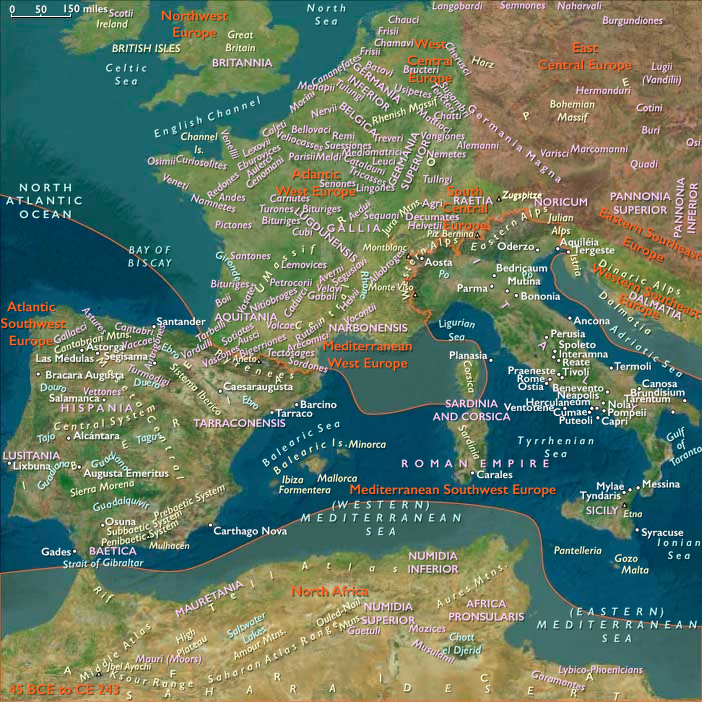
Southwest Europe
View →Subregions