
Northeast Europe (1828–1839 CE): Societal Progress, Cultural…
1828 CE to 1839 CE
Northeast Europe (1828–1839 CE): Societal Progress, Cultural Awakening, and Rising National Consciousness
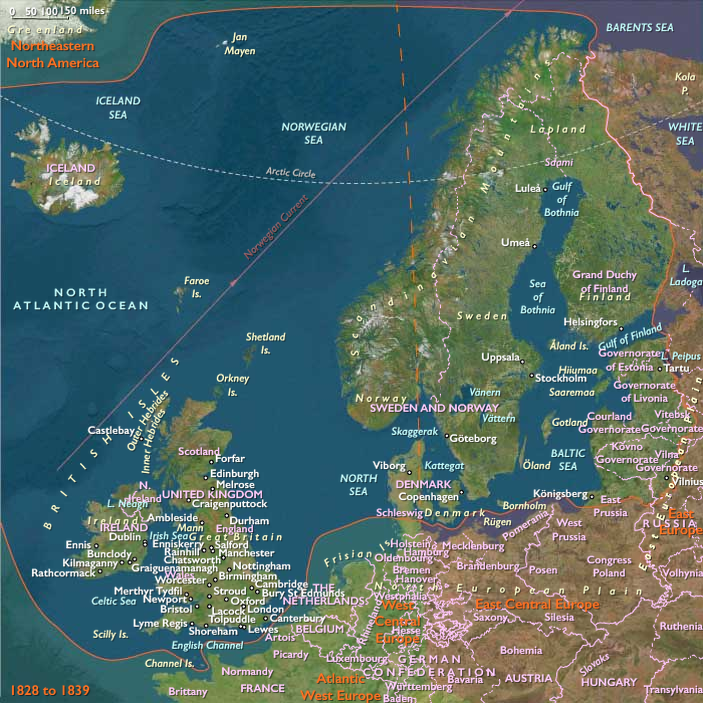
Between 1828 and 1839 CE, Northeast Europe experienced steady socioeconomic growth, cultural awakening, administrative consolidation, and the emergence of distinct expressions of national identity. Finland notably saw an intensified nationalist movement fostering its linguistic and cultural identity under Russian rule. The Swedish-Norwegian union navigated underlying tensions while Denmark, Prussia, and the Baltic territories pursued incremental socioeconomic and political progress, continuing their cautious internal reforms and economic development.
Finland: Linguistic Nationalism and Cultural Revival
Under the sovereignty of Tsar Nicholas I (r. 1825–1855), Finland continued to enjoy substantial autonomy and internal peace as a Grand Duchy within the Russian Empire. Finnish administrative structures, particularly the Senate composed of Finnish civil servants appointed by the tsar, facilitated stable governance. Economically, Finland advanced steadily through expanded trade and agriculture, reinforced by independent customs and taxation systems.
Most notably, this era witnessed significant growth in Finnish nationalism, particularly through linguistic and cultural developments. Previously dominated culturally and politically by the Swedish-speaking elite, Finland saw the rise of a distinct Finnish-language nationalist movement, known as the Fennoman movement, which emphasized Finnish language, literature, and cultural identity.
The leading advocate of this movement was philosopher and statesman Johan Vilhelm Snellman (1806–1881), who argued that promoting the Finnish language was essential for resisting cultural assimilation by Russia. Snellman stressed literature as crucial for fostering national consciousness, addressing the historic absence of Finnish-language secular literature, as previously Finnish publishing had been largely limited to religious texts.
A turning point occurred with the 1835 publication of the Kalevala, Finland's national folk epic, compiled by country doctor Elias Lönnrot. Practicing medicine along Finland’s eastern borders, Lönnrot meticulously gathered hundreds of folk ballads, weaving them into an epic narrative comprising nearly twenty-three thousand lines. The Kalevala became the cornerstone of Finnish literature, profoundly influencing Finland’s national self-awareness. Even into the late twentieth century, the Kalevala remained the preeminent work of Finnish cultural identity.
Finnish nationalism in this period, however, was complex and dualistic. Alongside the Finnish-language (Fennoman) movement, a parallel Swedish-language nationalist movement emerged, primarily among the Finnish-Swedish elite. This dual nationalism significantly shaped Finland’s evolving national identity and later facilitated its path toward independence.
The Russian government, initially supportive of Finnish linguistic nationalism, viewed it strategically as a means to prevent reintegration with Sweden. Indeed, the Russians had previously sought to weaken Swedish influence by relocating the Finnish capital from Turku (Åbo) to Helsinki in 1812, placing administrative power closer to St. Petersburg. This shift was reinforced by relocating the University of Turku to Helsinki following a catastrophic fire in 1827. The new University of Helsinki quickly emerged as a central hub for Finnish nationalism, providing intellectual and cultural momentum to the Fennoman cause.
A popular phrase coined during this era expressed Finland’s complex identity clearly: "We are no longer Swedes; we cannot become Russians; we must be Finns." This succinctly captured the essence of Finnish self-awareness as distinct from both Sweden and Russia.
Sweden-Norway: Navigating Union Tensions and Economic Integration
Under King Karl XIV Johan (Jean-Baptiste Bernadotte) (r. 1818–1844), Sweden and Norway continued their cautious coexistence within the personal union. Although political stability was maintained, underlying tensions persisted, especially with increasing Norwegian aspirations for greater autonomy. Economically, infrastructure investments and growing trade networks provided steady economic improvement in both kingdoms, bolstering internal stability despite national frictions.
Denmark: Continued Economic Stability and Social Development
Under the stable governance of King Frederick VI (r. 1808–1839), Denmark focused successfully on economic modernization and infrastructure enhancement. Agricultural productivity and maritime commerce in Copenhagen flourished, supporting overall economic resilience. Danish educational and cultural institutions thrived, further reinforcing societal progress and intellectual continuity.
Prussia: Ongoing Reform and Socioeconomic Strengthening
Under King Frederick William III (r. 1797–1840), Prussia continued its economic liberalization, agricultural reforms, and educational advancements. The strategically vital region surrounding Königsberg (Kaliningrad) benefited greatly from ongoing modernization efforts. These internal reforms enhanced Prussian societal cohesion and economic vitality, strengthening its regional influence.
Baltic Territories: Rural Transformation and Urban Prosperity
In the Baltic territories, especially in Estonia and Livonia (modern southern Estonia and northern Latvia), incremental social improvements continued following earlier serf emancipation (1816 and 1819, respectively). Rural society gradually benefited from increased rights, although economic disparities persisted due to ongoing aristocratic landownership by the Baltic-German nobility.
Urban centers such as Reval (Tallinn) and Riga maintained prosperity through maritime commerce and trade, supported by sustained administrative stability and regional integration.
Urban Economic Growth and Regional Development
Northeast European cities, including Stockholm, Copenhagen, Oslo, Helsinki, Königsberg, Riga, and Reval, steadily expanded in economic importance. Enhanced infrastructure, maritime trade, and commercial integration contributed to overall regional economic resilience and urban prosperity.
Cultural and Intellectual Flourishing
Educational and cultural institutions throughout Northeast Europe maintained intellectual vigor. Finland’s emerging cultural nationalism, exemplified by the influential Kalevala epic and the University of Helsinki’s prominence, significantly shaped regional identity. Danish, Swedish, and Prussian scholarly institutions continued flourishing, contributing robustly to Enlightenment ideals and scientific inquiry.
Diplomatic Caution and Internal Stability
Diplomatic relations remained cautious and pragmatic, emphasizing internal stability and economic growth over external conflict. Finland’s relationship with Russia continued amicably due to mutual acceptance of autonomy arrangements. Sweden-Norway prioritized economic integration despite union tensions, Denmark emphasized neutrality, and Prussia focused primarily on internal development.
Legacy of the Era
The era from 1828 to 1839 CE profoundly influenced Northeast Europe’s subsequent historical trajectory. Finland’s dynamic national awakening, driven by linguistic and literary achievements such as the Kalevala, profoundly reshaped Finnish identity and cultural consciousness. The dual nationalism (Finnish and Swedish) within Finland laid critical groundwork for eventual independence. Elsewhere, sustained economic and societal improvements in Sweden-Norway, Denmark, Prussia, and the Baltic territories contributed to regional resilience. Collectively, these developments formed essential foundations for Northeast Europe’s cultural evolution, national identities, and geopolitical transformations through the nineteenth century and beyond.
People
Groups
Commodities
Subjects
Regions
North Europe
View →Subregions
