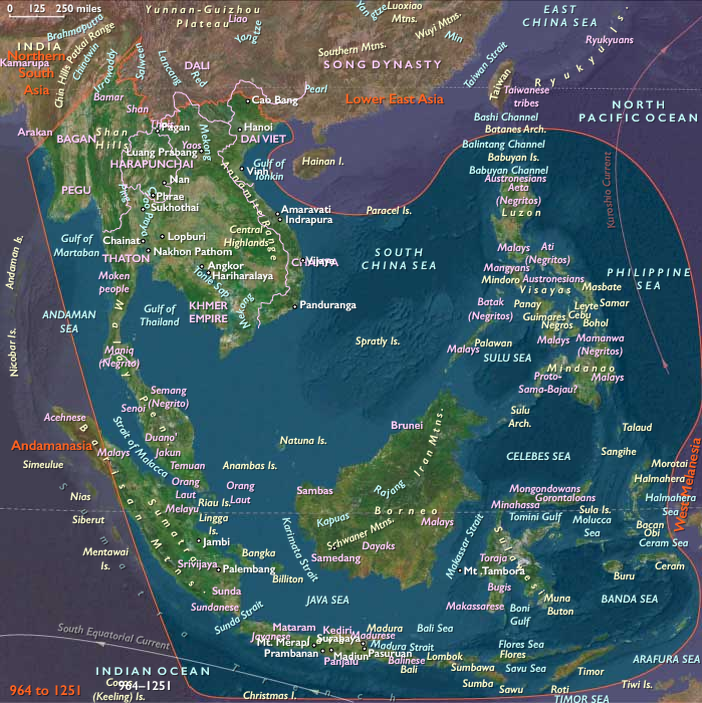
Southeastern Asia (1108 – 1251 CE): Angkor’s…
1108 CE to 1251 CE
Southeastern Asia (1108 – 1251 CE): Angkor’s Monumental Age, Pagan’s Golden Stupas, Dai Viet–Champa Rivalries, and Javanese–Srivijayan Shifts
Geographic and Environmental Context
Southeastern Asia includes southern and eastern Myanmar, Thailand, Cambodia, Laos, Vietnam, the Malay Peninsula, Sumatra (excluding Aceh and the western offshore islands), Java, Borneo, Sulawesi, and surrounding archipelagos (Bali–Timor, Banda, Moluccas, Ceram, Halmahera, and the Philippines).
-
Mainland: the Irrawaddy, Chao Phraya, Mekong, and Red River deltas supported population booms.
-
Insular: the Strait of Malacca, Java Sea, and Moluccas–Philippines–Sulawesi arcs were vital to spice and luxury trade.
-
The monsoon system continued to govern agriculture and sailing, while volcanic activity shaped Java and the eastern islands.
Mainland Southeast Asia
Myanmar (southern & eastern)
-
Pagan (Bagan) reached its golden age.
-
Anawrahta’s successors (Kyanzittha, 1084–1112; Alaungsithu, 1112–1167) continued expansion, securing irrigation and integrating Mon regions.
-
Bagan became a center of Theravāda Buddhism, building over 2,000 stupas and temples across the plain.
-
Monks and monasteries accumulated land, tying agrarian surplus to Buddhist patronage.
Thailand & Laos
-
The Mon Dvaravati polities faded, increasingly drawn into Pagan and Khmer spheres.
-
In the uplands of Laos, smaller Tai-speaking groups began pressing southward, laying early groundwork for future Lao polities.
Cambodia (Khmer Empire)
-
The Khmer Empire reached its architectural zenith.
-
Suryavarman II (1113–1150) constructed Angkor Wat, the world’s largest Hindu temple, dedicated to Vishnu.
-
Khmer influence extended into Laos and central Thailand.
-
After Suryavarman II’s death, internal instability weakened Khmer control, and pressure from Champa mounted.
Vietnam
-
The Lý dynasty (1009–1225) consolidated Vietnamese independence with its capital at Thăng Long (Hanoi).
-
Buddhism remained the ideological center of the state, supported by royal patronage.
-
Champa pressed northward, leading to frequent wars with Dai Viet.
-
Maritime ports in northern and central Vietnam grew in significance in China–Southeast Asia trade.
Champa (Central Vietnam)
-
The Cham kingdom thrived as a Shaiva Hindu state, building brick towers like Po Nagar and Mỹ Sơn.
-
Cham fleets engaged in both warfare and commerce, sometimes raiding Khmer and Vietnamese coasts.
-
The Cham polity became a key node for Indian Ocean and South China Sea exchange.
Insular Southeast Asia
Malay Peninsula
-
Kedah, Tambralinga, and other ports competed for control of Malacca trade.
-
Influence shifted between Srivijayan suzerainty and local independence.
-
Tin, forest products, and rice supplied merchant vessels between India and China.
Sumatra (excluding Aceh & western islands)
-
Srivijaya, once hegemonic, faced decline after Chola raids (c. 1025) weakened Palembang’s fleets and prestige.
-
By the 12th century, Srivijaya’s authority fragmented; smaller Sumatran ports asserted autonomy.
-
Nonetheless, Palembang and Jambi remained influential, continuing Buddhist patronage and straits control.
Java
-
Central and eastern Javanese courts gained prominence as Srivijaya waned.
-
Agrarian states like Kediri (11th–13th c.) flourished, producing literature (e.g., Kakawin Bharatayuddha, 1157).
-
Rice surpluses supported temple construction, Hindu-Shaiva cults, and maritime ventures.
-
Javanese fleets increasingly competed for straits dominance.
Borneo
-
Coastal settlements exported camphor, forest resins, and gold to China and India.
-
Srivijayan decline gave these ports more independence.
-
The Dayak interior maintained swidden cultivation and ancestor cults.
Sulawesi
-
Maritime chiefdoms at Makassar, Buton, and northern Sulawesi grew into major spice brokers.
-
Sulawesi navigators connected Moluccas and Banda cloves/nutmeg to Java and Philippines markets.
-
Political structures remained clan-based but increasingly tied to maritime power.
Eastern Archipelagos (Bali–Timor, Banda, Moluccas, Ceram, Halmahera, Philippines)
-
Bali became a Hindu-Buddhist kingdom, linked to Javanese culture but retaining local traditions.
-
Moluccas (Spice Islands): clove and nutmeg polities organized through chiefly alliances, guarded spice groves, and managed long-distance distribution.
-
Philippines: barangay polities became more hierarchical; datus consolidated power, controlling gold mines in Luzon and Visayas, and conducting trade with China, Champa, and Borneo.
-
Mindanao–Sulu polities expanded as key waystations for Moluccas–Philippines–China exchange.
Economy and Trade
-
Mainland: Angkor, Pagan, and Dai Viet exported rice, forest goods, and handicrafts; Champa exported aromatics, textiles, and pottery.
-
Insular: Srivijaya’s weakened control allowed Java, Sulawesi, and the Philippines to take larger shares of spice commerce.
-
Spices (cloves, nutmeg, mace) from Moluccas remained the linchpin of global demand.
-
Gold (Philippines, Sumatra), tin (Malay Peninsula), camphor (Borneo, Sumatra), and rice (Java) all entered Indian Ocean and South China Sea trade.
Belief and Symbolism
-
Angkor Wat epitomized Khmer divine kingship and cosmological symbolism.
-
Pagan’s temples enshrined Theravāda Buddhism as state orthodoxy.
-
Lý Vietnam promoted Buddhist monasteries as centers of learning and diplomacy.
-
Champa expressed Hindu identity through its brick sanctuaries and rituals.
-
Java blended Hindu-Buddhist cosmology in literature and temple culture.
-
Philippines–Moluccas: ancestor and sea-spirit cults prevailed, but Indic motifs entered through trade shrines.
Adaptation and Resilience
-
Angkor & Pagan harnessed hydraulic systems to mitigate flood/drought cycles.
-
Maritime redistribution ensured spice, rice, and luxury goods moved across seas even when one polity declined.
-
Multiple centers of power (Angkor, Pagan, Dai Viet, Champa, Java, Srivijaya, Sulawesi, Philippines) created redundancy, allowing the region to remain resilient despite warfare and piracy.
Long-Term Significance
By 1251 CE, Southeastern Asia was a multi-centered world:
-
Mainland rice empires (Angkor, Pagan, Dai Viet) anchored agrarian economies with monumental temple states.
-
Maritime powers (Java, Srivijaya remnants, Sulawesi chiefdoms, Philippine barangays, Spice Islands) controlled sea-lanes and spice flows.
-
The age marked the apogee of Angkorian and Pagan monumentality, the literary flowering of Java, the consolidation of Dai Viet, and the rise of Philippine and Sulawesi chiefdoms as indispensable spice brokers.
Southeastern Asia in this age stood as both a granary of the monsoon world and the crossroads of the global spice trade, balancing monumental kingship inland and maritime federations across its seas.
Groups
Commodities
Subjects
Regions
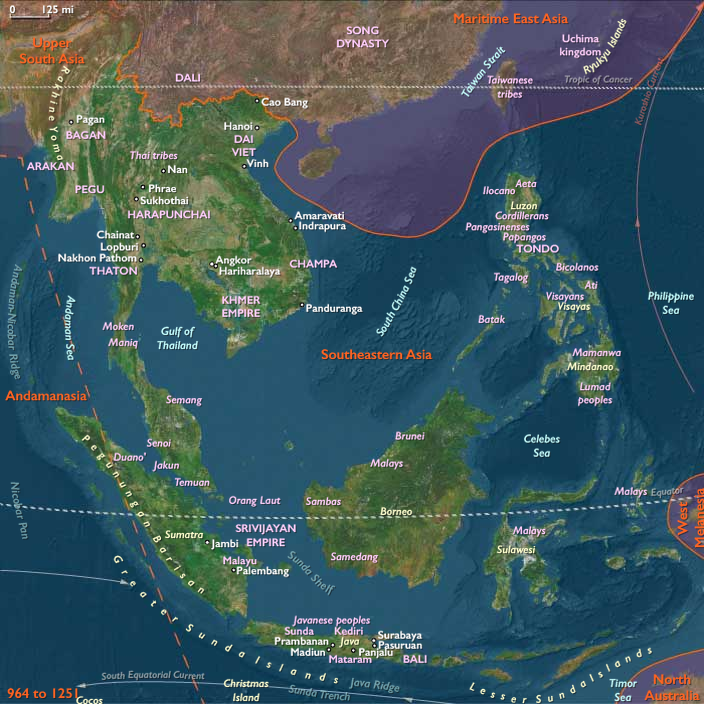
Southeast Asia
View →Subregions