Southeast Asia (1108 – 1251 CE): Monumental…
1108 CE to 1251 CE
Southeast Asia (1108 – 1251 CE): Monumental Kingdoms and Maritime Gateways
Between 1108 and 1251 CE, Southeast Asia stood at the height of its classical age—a landscape of radiant temples and golden stupas inland, and of spice-laden ships and cosmopolitan ports at sea. From the rice granaries of Angkor and Pagan to the entrepôts of Barus, Champa, and Java, this was an era when kingship, trade, and religion converged under the rhythm of the monsoon. The Medieval Warm Period brought stability and abundance, allowing agrarian empires and maritime polities alike to flourish across the world’s most dynamic crossroads.
Geographic and Environmental Context
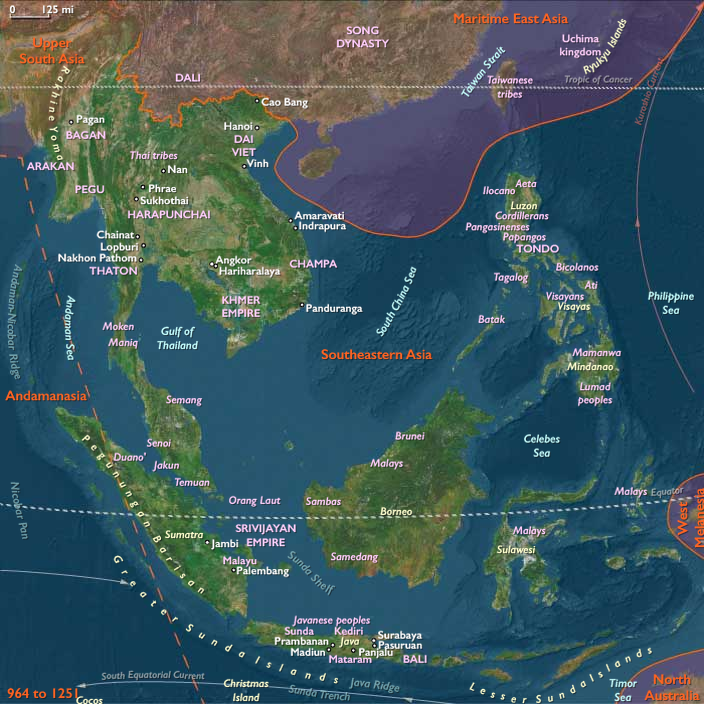
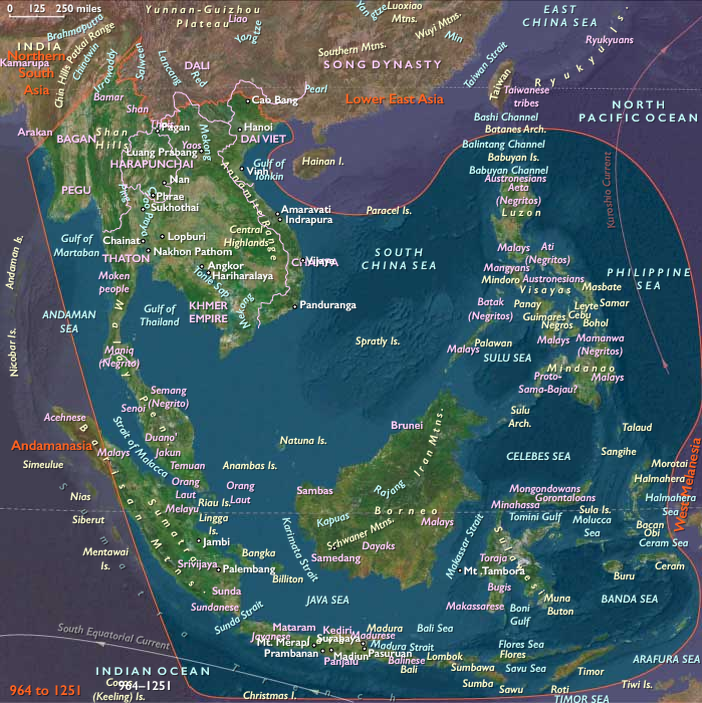
Southeast Asia encompassed both the mainland deltas—the Irrawaddy, Chao Phraya, Mekong, and Red Rivers—and the insular archipelagos of Sumatra, Java, Borneo, Sulawesi, and the Philippines.
Forested uplands and volcanic coasts fed broad floodplains of rice cultivation, while maritime straits—the Malacca, Makassar, and Banda—connected the Indian Ocean and South China Sea.
To the west, the Andaman and Nicobar Islands linked Bengal and Sumatra; to the east, the Moluccas and Philippines carried the world’s most coveted spices—cloves, nutmeg, and mace.
Together, these lands formed the pivotal hinge between South Asia, East Asia, and the Indo-Pacific.
Climate and Environmental Shifts
The Medieval Warm Period stabilized monsoons, sustaining double-crop rice systems on the mainland and abundant reef fisheries in the islands.
Warm seas and fertile deltas fostered demographic expansion; temple irrigation and canal systems extended into marginal lands.
Periodic typhoons struck the South China Sea, and cyclones swept the Bay of Bengal, but the sheer environmental diversity of the region made it resilient.
Volcanic activity on Java and the Moluccas renewed soils even as it periodically displaced settlements.
Overall, favorable climate and hydrology underpinned both monumental construction and maritime commerce.
Mainland Empires: Angkor, Pagan, Dai Viet, and Champa
The mainland was dominated by three monumental powers:
-
Khmer Empire (Cambodia):
Under Suryavarman II (r. 1113–1150), the Khmer state reached its artistic and architectural zenith with the construction of Angkor Wat, dedicated to Vishnu. The temple’s concentric galleries and celestial symbolism embodied divine kingship (devarāja). Khmer armies and engineers extended control into Laos and Thailand, while canal and reservoir systems sustained immense rice surpluses.
After Suryavarman’s death, internal strife and external pressure from Champa gradually eroded unity, but Angkor remained the supreme architectural expression of Southeast Asia’s Hindu-Buddhist synthesis. -
Pagan (Bagan, Myanmar):
Under Anawrahta’s successors, the Pagan kingdom consolidated upper and lower Burma, integrating Mon regions and spreading Theravāda Buddhism. By the mid-12th century, over two thousand stupas and temples adorned the Irrawaddy plain, including the grand Shwezigon and Ananda shrines. Monastic estates became centers of literacy, irrigation, and cultural patronage, making Bagan the northern counterpart to Angkor. -
Dai Viet and Champa (Vietnam):
The Lý dynasty (1009–1225) solidified independence from China, establishing a stable capital at Thăng Long(Hanoi) and supporting Buddhist institutions.
To the south, Champa, centered at Mỹ Sơn and Po Nagar, upheld Shaiva Hinduism and maritime power, alternating between war and trade with its northern neighbor. Their rivalry defined the political axis of the eastern mainland for two centuries.
In the uplands of Laos and northern Thailand, Tai-speaking groups began moving southward, seeding the future Lao and Thai kingdoms that would flourish in later centuries.
Maritime Realms: Java, Sumatra, Sulawesi, and the Philippines
Across the seas, a parallel order thrived—one of fleets, ports, and spices.
-
Java:
With the decline of Srivijaya after the Chola raids (c. 1025), the agrarian courts of Kediri and Panjalu ascended in central and eastern Java.
Literary masterpieces like the Kakawin Bharatayuddha (1157) celebrated Hindu epics in local verse, while rice surpluses financed temples and trade.
Java’s maritime fleets increasingly dominated the Strait of Malacca, shifting the region’s economic gravity eastward. -
Sumatra:
Palembang and Jambi, remnants of Srivijaya, continued as Buddhist and mercantile hubs, exporting gold, camphor, and forest goods.
Northern ports such as Lambri and Barus rose to prominence as independent entrepôts—famed in Song Chinese and Arab records for elephants, camphor, and spices.
Aceh and its offshore islands—Nias, Simeulue, and the Mentawais—maintained Austronesian horticultural and ritual traditions alongside growing international trade. -
Malay Peninsula:
Ports such as Kedah and Tambralinga competed for tin and forest exports, oscillating between Srivijayan allegiance and autonomy.
These entrepôts served as midpoints between the Bay of Bengal and the Java Sea, crucial to the movement of goods and ideas. -
Sulawesi and the Eastern Archipelagos:
Chiefdoms at Makassar, Buton, and Halmahera became brokers in the growing spice trade, connecting the Moluccas’ cloves and nutmeg with Javanese and Chinese merchants.
Bali, contemporaneously, blended Indian and indigenous beliefs into a distinctive Hindu-Buddhist culture of temple kingdoms. -
Philippines:
By this era, barangay polities under datus had matured into regional chiefdoms.
Luzon’s goldfields and Visayan trade ports attracted merchants from China, Champa, and Borneo, while Mindanao–Sulu polities served as key intermediaries in the clove and nutmeg trade.
Andamanasia: The Northern Maritime Corridor
At the edge of the Bay of Bengal, Andamanasia linked the Indian Ocean to the Pacific.
-
Andaman and Nicobar Islands:
Small, kin-based hunter-gatherer and horticultural communities maintained autonomy, practicing forest and reef subsistence.
Nicobarese traded coconuts, taro, and ornaments with visiting sailors.
The isolated Andamanese continued their ancient foraging lifeways. -
Northern Sumatra and Offshore Islands:
Lambri and Barus flourished as cosmopolitan ports of call, recorded by Arab, Persian, and Chinese geographers.
Barus’ camphor and Lambri’s elephants became staples of global luxury trade.
Inland, Nias and Mentawai developed fortified villages and megalithic rituals symbolizing rank and abundance, their stone monuments testifying to complex social order.
Aceh’s strategic coast grew as a maritime gateway that would later anchor Islamic trade routes.
Economy and Trade
Southeast Asia’s wealth flowed along two great arteries:
-
The Mainland Grain Belt, exporting rice, forest goods, and textiles from Angkor, Pagan, and Dai Viet;
-
The Maritime Spice Circuit, dominated by Java, Sulawesi, and the Philippines.
Cloves, nutmeg, and mace from the Moluccas remained the cornerstone of transoceanic commerce, while gold, tin, camphor, and aromatics fed Indian and Chinese markets.
Ships from Arabia, Gujarat, and Song China converged at ports like Palembang, Barus, Champa, and Kedah.
This intricate lattice of trade, monsoon-driven and cosmopolitan, linked Buddhist monks, Hindu Brahmins, and Muslim merchants in a continuous circuit of goods and ideas.
Belief and Symbolism
Religion infused every expression of Southeast Asian life.
-
Angkor Wat symbolized the cosmic Mount Meru;
-
Pagan’s temples enshrined the Theravāda canon;
-
Champa’s brick sanctuaries honored Shiva and the sea;
-
Java’s courts harmonized Hindu-Buddhist cosmology with local spirit cults;
-
Andamanasian societies venerated forests, ancestors, and sea spirits;
-
Ports like Lambri and Barus blended indigenous, Hindu-Buddhist, and early Islamic practices.
Across the region, sacred architecture, pilgrimage, and ritual exchange expressed a unified vision: that kingship, cosmos, and the monsoon itself were part of the same divine cycle.
Adaptation and Resilience
Diversity and connectivity defined Southeast Asia’s resilience.
-
Hydraulic engineering at Angkor and Pagan stabilized agriculture through drought and flood.
-
Coastal and island polities offset ecological vulnerability through maritime redistribution.
-
Decentralized trade ensured continuity when any single power waned.
-
Cultural pluralism absorbed shocks—Hindu, Buddhist, and indigenous traditions merged rather than replaced one another.
From the high temples of Angkor to the sea-harbors of Sumatra, adaptation meant integration—of climate, belief, and commerce.
Long-Term Significance
By 1251 CE, Southeast Asia was the vibrant center of the medieval tropics:
-
Angkor and Pagan crowned the agrarian world with stone and faith.
-
Dai Viet and Champa defined the frontier between Indic and Sinic civilizations.
-
Java and the Moluccas supplied the world’s spices.
-
Lambri, Barus, and Aceh opened the Indian Ocean to new global circuits.
-
The Philippines and Sulawesi matured into indispensable nodes of maritime exchange.
This was the Monumental Age—when Southeast Asia stood as both temple and marketplace, its inland empires radiating grandeur and its seaways carrying the wealth of the world.
Groups
Commodities
Subjects
Regions