Southeast Asia (1540–1683 CE) Maritime Crossroads, Imperial…
1540 CE to 1683 CE
Southeast Asia (1540–1683 CE)
Maritime Crossroads, Imperial Currents, and Island Frontiers
Geography & Environmental Context
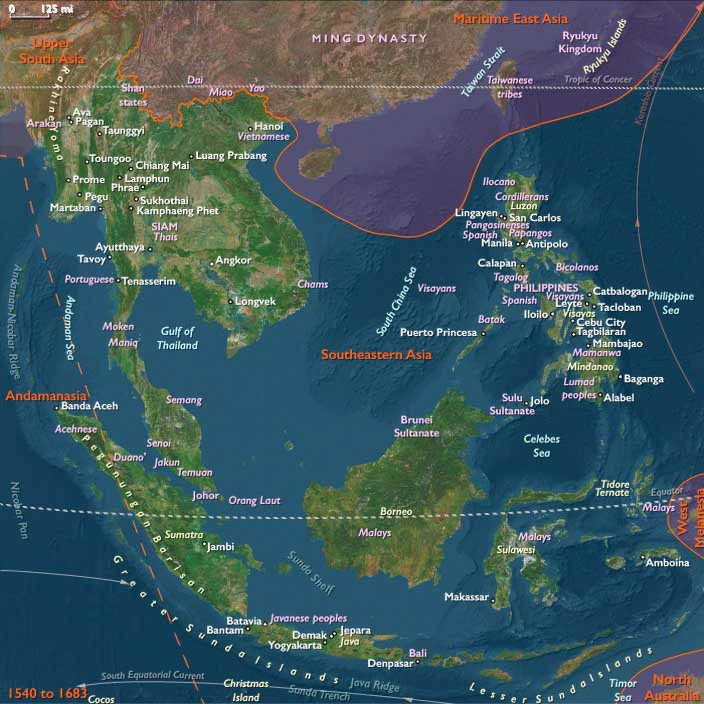
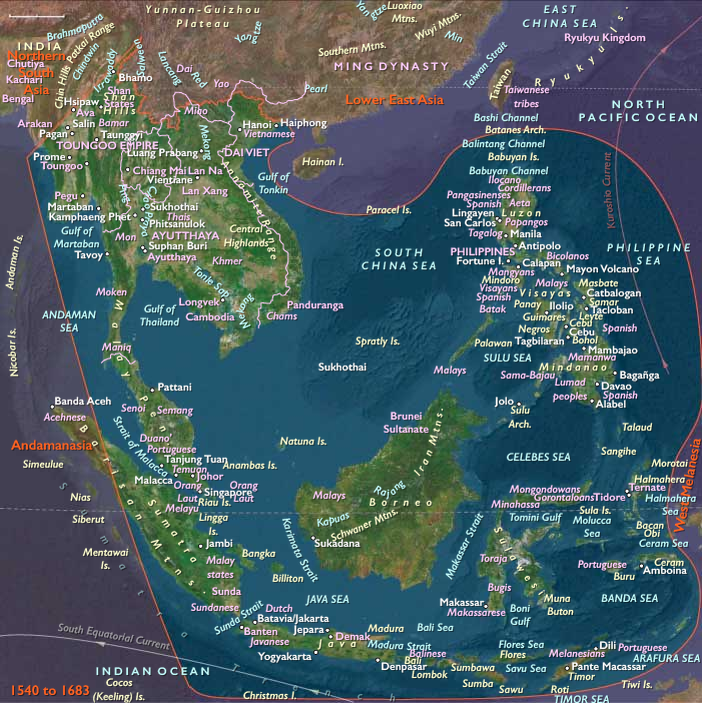
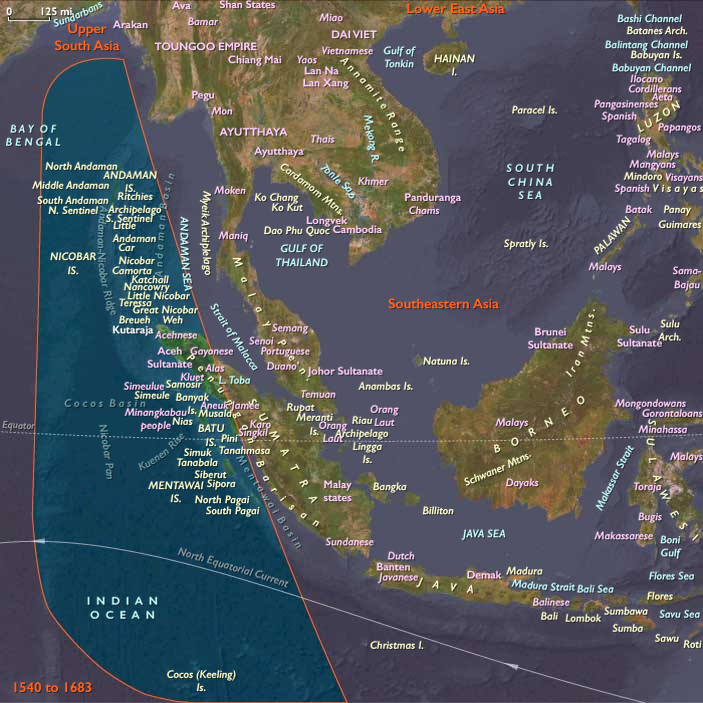
The region of Southeast Asia, spanning from the Indochinese and Malay Peninsulas to the archipelagos of Sumatra, Java, Borneo, Sulawesi, the Philippines, and the Moluccas, and westward across Aceh, Simeulue, Nias, and the Andaman and Nicobar Islands, formed one of the world’s most dynamic cultural and maritime crossroads. Anchors included the Irrawaddy, Chao Phraya, Mekong, and Red River basins; the volcanic ridges of Java; the Strait of Malacca; the pepper fields of Sumatra; and the spice islands of Maluku, where cloves and nutmeg drew traders from every ocean. Westward, Andamanasia’s forested islands and coral arcs linked South and Southeast Asia through the Bay of Bengal and the Indian Ocean. The region’s geography—monsoonal rivers, fertile volcanic soils, coral reefs, and narrow straits—made it both the hinge of Asia’s commerce and a contested frontier of empire.
Climate & Environmental Shifts
During the Little Ice Age, monsoon variability intensified. Wet and dry seasons fluctuated sharply, and El Niño droughts periodically reduced rice harvests from the Mekong to Java, while La Niña floods swelled deltas and damaged dikes. Cyclones struck the Andaman Sea, Bay of Bengal, and Philippine coasts, while volcanic eruptions in Java and the Moluccas disrupted crops but renewed soil fertility. In Andamanasia, tsunamis and earthquakes periodically reshaped coastlines—disasters recorded in oral traditions such as Simeulue’s smong tales. Despite these hazards, ecological diversity—from upland forests to mangrove deltas—provided resilience through regional exchange.
Subsistence & Settlement
-
Mainland and Island Heartlands (Southeastern Asia):
-
The great river plains—Irrawaddy, Chao Phraya, Mekong, Red River—were the rice granaries sustaining Ayutthaya, Lan Xang, and Nguyen–Trinh Vietnam.
-
Java, under the Mataram Sultanate, and Sumatra’s pepper coast combined wet-rice farming with spice and tin export.
-
Borneo, Sulawesi, and the Philippines relied on mixed agriculture: rice, sago, root crops, and coconuts, supplemented by rich fisheries and inter-island trade.
-
Urban nodes—Ayutthaya, Malacca, Batavia, and Manila—linked inland agrarian economies to global circuits of silver and spice.
-
-
Island Frontiers (Andamanasia):
-
Aceh dominated the Strait of Malacca, cultivating rice and pepper and commanding trade routes through its fortified capital at Banda Aceh.
-
Outlying islands—Simeulue, Nias, Mentawai—combined root crops, coconuts, and fishing with megalithic ritual life.
-
The Andaman and Nicobar Islands sustained mobile foragers and horticulturalists who harvested forest yams, fruits, and marine resources.
-
The Cocos–Keeling and Preparis–Coco islets remained uninhabited yet served as navigation waypoints for Malay, Arab, and Portuguese sailors.
-
Technology & Material Culture
-
Agriculture: Sophisticated irrigation networks and terracing underpinned dense populations in mainland and island kingdoms.
-
Shipbuilding: Southeast Asia’s fleets—praus, lanong, and junks—combined Austronesian and Asian techniques, forming the era’s finest maritime technology.
-
Weaponry and metallurgy: Ironworking and bronze casting flourished; Aceh’s cannon foundries rivaled Ottoman and European craftsmanship.
-
Architecture: Wooden palaces, brick temples, and coral mosques embodied cultural fusion—Hindu-Buddhist motifs alongside Arabic calligraphy and Portuguese arches.
-
Textiles and crafts: Batik in Java, ikat in Sulawesi, and woven sinamay in the Philippines served as currency and prestige goods.
Movement & Interaction Corridors
Southeast Asia’s seas and rivers were global arteries of exchange:
-
The Straits of Malacca united the Indian Ocean and South China Sea, channeling silks, ceramics, and spices.
-
The Moluccas exported cloves and nutmeg to Arab, Indian, Chinese, and eventually European traders, who competed violently for monopoly.
-
Manila, after 1565, became the hinge of the Pacific world, receiving Mexican silver in exchange for Asian goods via the galleon trade.
-
Aceh’s navy clashed with Portuguese Malacca, aided by Ottoman artillery; its trade networks reached Mecca and Istanbul.
-
Andaman and Nicobar coasts offered temporary harbors for Bay of Bengal sailors, while Cocos–Keeling marked the open-ocean route toward the Indian Ocean rim.
Cultural & Symbolic Expressions
-
Religious pluralism and synthesis:
-
Islam spread through the Malay world via traders and scholars, shaping courts in Aceh, Banten, Makassar, and Demak.
-
Theravada Buddhism dominated Ayutthaya, Lan Xang, and Cambodia, producing monumental temples and mural art.
-
Catholicism took root in the Philippines under Spanish rule, fusing Christian ritual with indigenous practice.
-
In Andamanasia, Islamic statecraft in Aceh coexisted with ancestor veneration and shamanic rites in outer islands and forested archipelagos.
-
-
Courtly and artistic life:
-
Wayang kulit theater in Java merged Hindu epics with Islamic parables.
-
Kava ceremonies in island polities and Malay epics like Hikayat Hang Tuah celebrated honor and maritime adventure.
-
Across Andamanasia, oral poetry, feasting, and megalithic monuments embodied clan memory and spiritual balance.
-
Environmental Adaptation & Resilience
-
Irrigated rice systems insulated mainland polities from drought cycles.
-
Volcanic agriculture in Java and the Moluccas thrived on renewal after eruptions.
-
Atoll and island adaptation: Coconut groves, sago forests, and lagoon fisheries stabilized small-island economies.
-
Kinship and tribute networks redistributed surpluses after disasters.
-
Maritime flexibility: Fishing, inter-island trade, and mobility provided social and ecological insurance across the archipelagos.
Technology & Power Shifts (Conflict Dynamics)
-
Portuguese Malacca (after 1511) disrupted regional trade, prompting Aceh and Johor to contest control of the strait.
-
Spanish colonization of the Philippines (after 1565) linked Asia to the Americas.
-
Dutch (VOC) dominance in Java (from 1602) and English competition in Sumatra and the Bay of Bengal realigned commerce under European monopolies.
-
Aceh, fortified with Ottoman alliances and gunpowder weapons, briefly challenged Iberian powers but declined after Sultan Iskandar Muda’s death (1636).
Transition
Between 1540 and 1683, Southeast Asia flourished as a maritime and mercantile world of dazzling cultural fusion and political rivalry.
-
In Southeastern Asia, great agrarian kingdoms and maritime sultanates—Ayutthaya, Mataram, Aceh, Makassar—commanded global trade while integrating Islam, Buddhism, and indigenous traditions.
-
In Andamanasia, Aceh’s empire, the outer island rituals, and the independence of the Andaman and Nicobar foragers preserved diversity beyond the reach of empire.
Yet the balance was shifting: European expansion introduced new commodities, faiths, and conflicts that began to reorder the monsoon world. By 1683, Southeast Asia stood as the pivot between Asia and Europe, its spice-laden ports and forested islands already drawn into the early global economy—poised on the threshold of colonization and transformation.
Groups
Topics
Commodities
Subjects
Regions