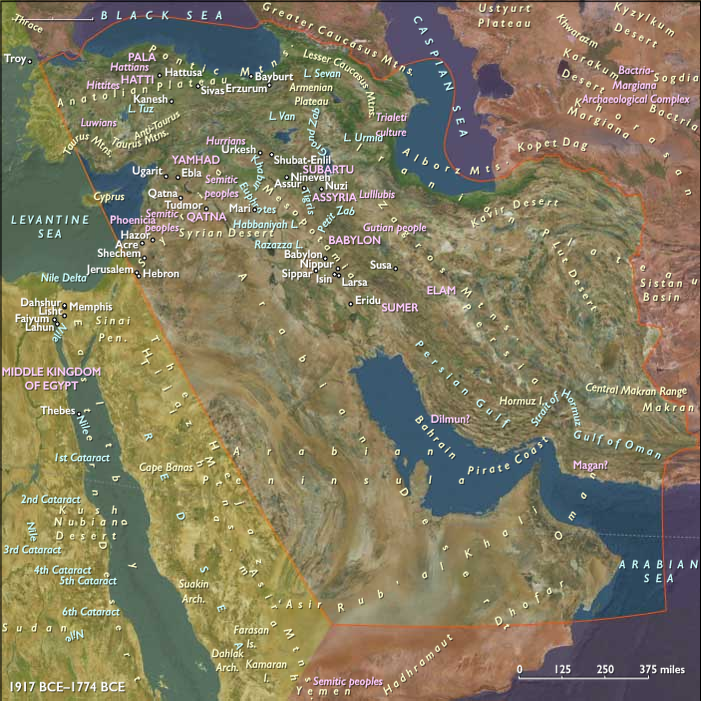
The Middle East: 1917–1774 BCE Rise of…
1917 BCE to 1774 BCE
The Middle East: 1917–1774 BCE
Rise of Babylon, Amorite Dominance, and Expanding Trade Networks
Emergence and Ascendancy of Babylon
Between 1917 and 1774 BCE, the Middle East underwent significant transformations marked by the emergence of Babylon, a previously minor town on the Euphrates River, as the capital of an expansive Amorite kingdom. Under the Amorites, Babylon rose swiftly in prominence, becoming the political and cultural heart of the region. This period culminated in the rule of Hammurabi (1792–1750 BCE), whose reign significantly expanded Babylon's territorial control from the Persian Gulf and Sumer in the south to Assyria in the north.
Hammurabi's Legal Innovations
King Hammurabi established a sophisticated administrative system designed to govern a vast territory efficiently. His most renowned legacy, however, is the Code of Hammurabi, a comprehensive legal codex emphasizing justice, social order, and protection of the weak. Though not the earliest, Hammurabi's code stands out as the most complete ancient legal document, addressing issues such as land tenure, marital laws, inheritance, debt management, public order, and labor conditions, setting foundational principles for Mesopotamian society.
Trade and Economic Shifts
Trade experienced considerable growth during the early second millennium BCE, reflected in the continued wealth of the maritime trade center Dilmun. However, around 1800 BCE, Dilmun's importance began to decline, partially due to a downturn in Mesopotamian markets and the emergence of alternative trade routes. A newly developed route linked India with the Mediterranean via the Arabian Sea, the Gulf of Aden, and the Red Sea, facilitated by Egyptian infrastructure, thereby significantly reshaping regional commerce.
Conflict Between Larsa and Isin
Following the collapse of the Third Dynasty of Ur in 2004 BCE, a fierce rivalry emerged between the city-states of Larsa and Isin. Larsa, influenced heavily by Elamite culture, opposed the more Amorite-oriented Isin. Tensions intensified when Amorite leaders seized power in both cities. Gungunum of Larsa, initially appointed governor by Isin, eventually rebelled, capturing the economically strategic city of Ur. This move severely weakened Isin, contributing to its rapid political and economic decline.
Amorite and Sumerian Cultural Dynamics
Although the Sumerian people effectively disappeared following the Ur III collapse, their cultural heritage continued profoundly influencing Amorite successors. The Semitic Akkadian language replaced Sumerian in everyday use, though Sumerian persisted as a liturgical and scholarly language for many centuries thereafter. Amorite kingdoms integrated Sumerian institutions, such as administrative systems and architectural forms, blending them with their distinct cultural identities.
Assyrian Strength and Independence
Northern Mesopotamia witnessed the ascent of Assyria as a major power, centered around cities like Assur and Nineveh. Assyria successfully resisted Amorite incursions, consolidating its independence by 1900 BCE under the dynasty founded by Puzur-Ashur I. Notably powerful was King Ilushuma (1953–1935 BCE), who led military expeditions into southern Mesopotamia and established Assyrian colonies in Asia Minor. The Assyrians, pioneering military innovations such as reliable metal swords, greatly influenced regional warfare.
Anatolian Changes: Hattians and Hittites
In central Anatolia, the Hattian people, speaking a non-Indo-European language, were gradually supplanted or assimilated by the Indo-European-speaking Hittites. Hittite cultural integration was marked by the absorption of Hattian religious and mythological traditions, adopting local deities such as the Sun Goddess and the Storm God. Hittite entry into Anatolia around 1900 BCE triggered population displacements across the region, significantly reshaping demographics in Anatolia and Greece.
Expanding Anatolian Trade and Colonization
Kanesh (Kültepe) in central Anatolia emerged as a critical hub in Assyrian trade networks, hosting extensive merchant colonies (karum) from about 1920 to 1840 BCE. These Assyrian trading posts facilitated the exchange of metals and textiles for precious metals, significantly bolstering regional economies until a catastrophic destruction around 1836 BCE temporarily halted activity.
Resettlement and Urban Revivals
Post-collapse resettlements occurred around 1900 BCE, including the foundation of important trading cities such as Palmyra (Tadmor), which became vital in connecting Mesopotamia and Syria to Mediterranean trade routes. Cities like Mari also experienced a revival under Amorite rule, marking a second golden age around 1825 BCE. Likewise, Ebla and Ugarit regained prominence, influenced culturally and politically by Egypt.
Cultural and Linguistic Developments
The Hurrians, speaking a distinct ergative-agglutinative language unrelated to Indo-European or Semitic tongues, emerged prominently in northern Mesopotamia around 2000 BCE. They adopted Akkadian cuneiform script, further integrating themselves into the regional cultural landscape. Concurrently, Elamite influence peaked under the Epartid dynasty in Susa (1900–1700 BCE), with constant interactions and conflicts involving Mesopotamian states.
This period represents a dynamic era of cultural exchanges, significant migrations, administrative innovations, and extensive trade expansions, setting the stage for the powerful empires and civilizations that followed in the Middle East.
Groups
Commodities
Subjects
Regions
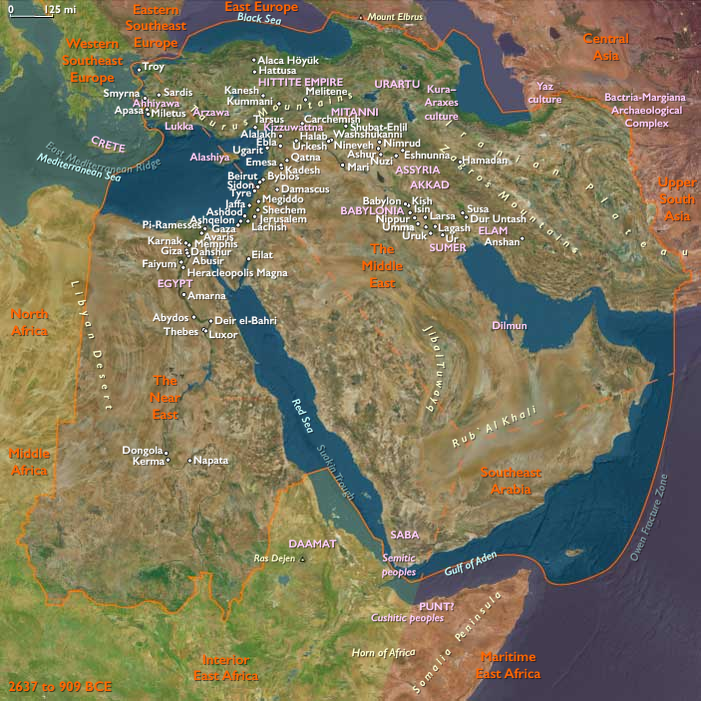
The Near and Middle East
View →Subregions