Central Europe (1540–1683 CE) Confessional Conflict, Habsburg…
1540 CE to 1683 CE
Central Europe (1540–1683 CE)
Confessional Conflict, Habsburg Resilience, and the Thirty Years’ War
Geography & Environmental Context
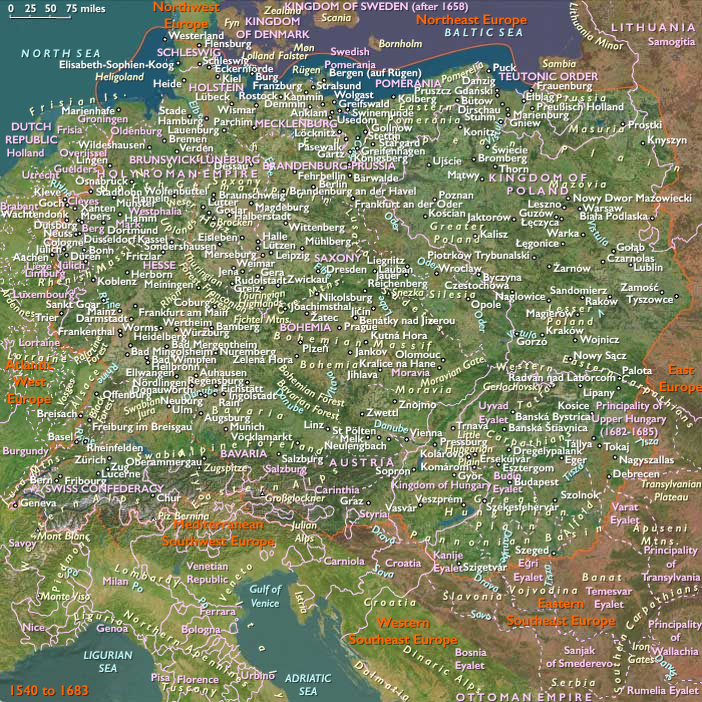
Central Europe stretched from the Rhine and Vistula basins to the Alps and Carpathian frontiers, encompassing modern Germany, Austria, Switzerland, Czechia, Poland’s southwest, and western Hungary. This was the pivot of the Holy Roman Empire—where Habsburg Austria, German principalities, and Swiss and south German cantonsmet amid mountain barriers and great river arteries.
The Little Ice Age imposed harsh winters and shortened growing seasons, with floods on the Elbe and Danubealternating with droughts that strained peasant economies. Yet fertile valleys and thriving trade routes sustained recovery after war and plague.
Subsistence & Settlement
-
Agriculture: Rye, barley, oats, and wheat dominated; hops, vines, and orchards thrived in Franconia, Bohemia, and the Rhine–Danube corridor. Alpine pastures supported dairying. Three-field rotation prevailed, while communal land and forest regulation structured rural economies.
-
Urban life: Vienna, Prague, Leipzig, Strasbourg, and Basel anchored regional commerce and intellectual life. Market towns revived slowly after mid-century devastation, relying on fairs and guild crafts.
-
Proto-industry: Mining (silver in Saxony, salt in Salzburg), linen weaving, and arms production fueled local trade, while mercenary service became a major livelihood.
Technology & Material Culture
Agrarian tools remained traditional—wooden plows and scythes—yet mills and forges multiplied. Printing, glassmaking, and clockmaking expanded urban economies. Architecture reflected confessional division: BaroqueCatholic churches rose alongside austere Protestant halls. Timber-framed houses, wool garments, and pewter or ceramic household goods characterized everyday life, while elites displayed imported silks and furniture acquired through fairs such as Leipzig and Frankfurt.
Movement & Interaction Corridors
-
Trade routes: The Elbe, Rhine, and Danube tied inland regions to the North Sea and Mediterranean.
-
Leipzig Fairs: Linked Italian, Low Country, and Baltic merchants.
-
Pilgrimage & learning: Protestant and Catholic centers alike—Wittenberg, Jena, Vienna, Innsbruck—attracted students and reformers.
-
Military corridors: Armies marched repeatedly through Saxony, Bohemia, and Austria, transforming the landscape during the Thirty Years’ War.
Cultural & Symbolic Expressions
Religious upheaval reshaped art, music, and learning.
-
Reformations: From Luther’s theses (1517) through mid-17th century, Protestantism divided the empire into Lutheran, Reformed, and Catholic zones.
-
Counter-Reformation: Jesuit colleges, baroque festivals, and pilgrimage revivals reasserted Catholic power, especially in Austria, Bavaria, and Bohemia.
-
Humanism & printing: Basel and Strasbourg spread Erasmus’s and Luther’s writings, uniting the region with the Republic of Letters.
-
Music: Early baroque composers and chorales anticipated the later genius of Bach and Handel.
-
Ritual & identity: Feast days, guild pageants, and processions persisted, though now split along confessional lines.
Environmental Adaptation & Resilience
-
Communal management: Three-field systems and common pastures reduced famine risk.
-
Forestry codes: Responded to timber shortages.
-
Urban granaries and parish charity: Buffered crises during plague and war.
-
Reconstruction: After devastation, towns rebuilt in Baroque style, while re-peopling campaigns revived deserted lands.
Political & Military Shocks
-
Habsburg consolidation: Vienna became the Catholic bulwark of Europe, facing Protestant uprisings and Ottoman sieges.
-
Schmalkaldic War (1546–47): Early Protestant alliance crushed but not extinguished.
-
Bohemian Revolt (1618) ignited the Thirty Years’ War, spreading devastation across Germany and Austria.
-
Peace of Westphalia (1648): Ended the war, recognized confessional equality, and decentralized the Holy Roman Empire.
-
Swiss autonomy: Formally confirmed, inaugurating neutrality.
-
Brandenburg-Prussia: Emerged from the ruins with a disciplined army and bureaucratic ethos.
-
Ottoman threat: The frontier in Hungary and Croatia remained active; the Siege of Vienna (1683) marked the climax of eastern pressure.
Regional Variations
East Central Europe:
Religious wars scarred Bohemia, Saxony, and Silesia, where Protestant and Catholic armies alternated occupation. The Habsburgs reimposed Catholicism in Bohemia after 1620, expelling nobles and confiscating estates.
South Central Europe:
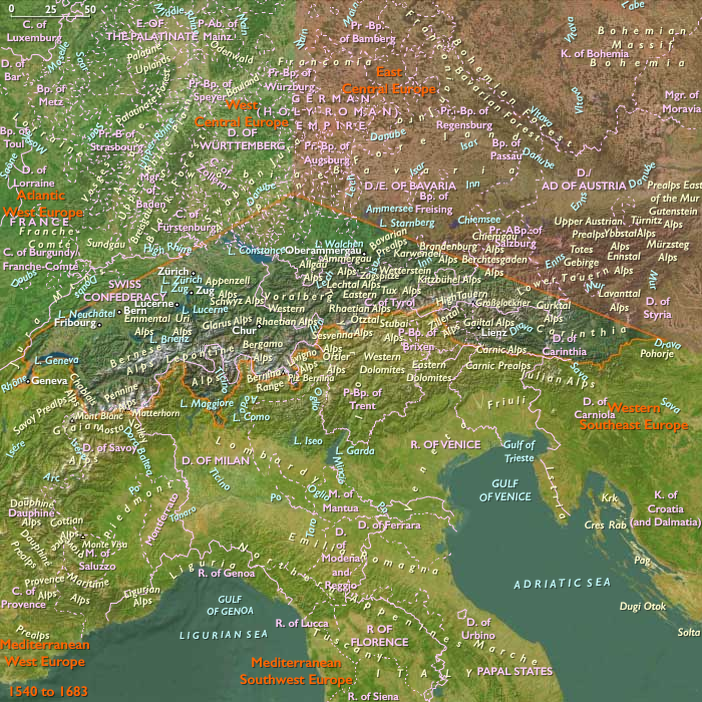
The Swiss Confederation and Austrian Alps balanced neutrality, trade, and mercenary export. The Swiss Peasant War (1653) and First War of Villmergen (1656) exposed social and confessional fissures, even as baroque Catholic revival flourished in southern Austria.
West Central Europe:
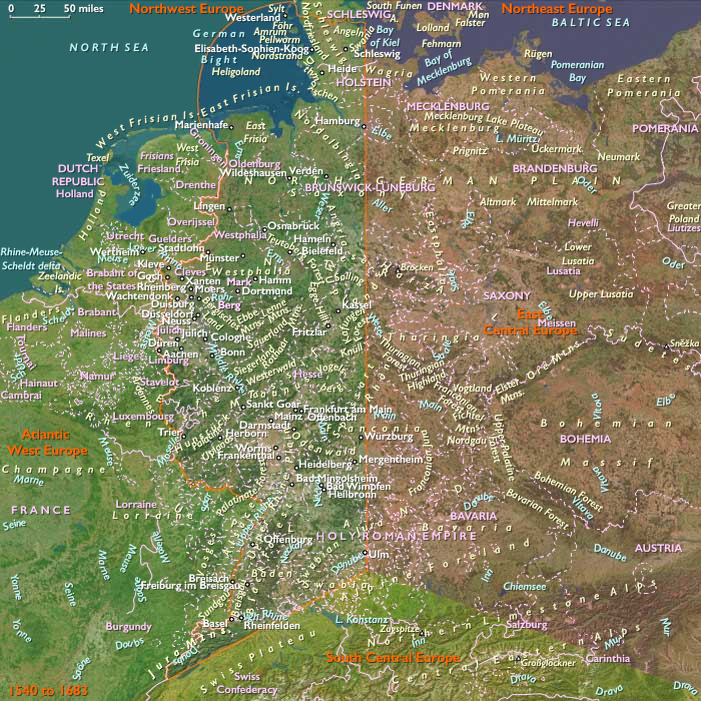
The Rhine corridor became a crucible of war and culture: Strasbourg, Mainz, and Heidelberg changed hands repeatedly. Printing houses sustained the Reformation’s voice; the Jesuit Counter-Reformation rebuilt cathedrals and schools. After 1648, Alsace passed to France, shifting the regional balance.
Transition
Between 1540 and 1683, Central Europe was torn by faith and empire, yet forged enduring institutions. The Reformation and Counter-Reformation defined its intellectual life; the Thirty Years’ War shattered populations and economies but yielded a new balance through the Peace of Westphalia.
By 1683, Habsburg Austria had repelled the Ottomans and emerged dominant in the Danube basin; Switzerland was neutral; Brandenburg-Prussia was rising; and the Rhine world straddled French and German spheres. Out of devastation came the seeds of the modern state, the baroque city, and a fragile confessional peace that would guide Europe’s next century.
Images

West Central Europe (with civilization) ©2024-25 Electric Prism, Inc. All rights reserved.
Groups
Topics
Commodities
Subjects
Regions