
North Europe (1540–1683 CE) Empires of …
Years: 1540 - 1683
North Europe (1540–1683 CE)
Empires of Faith, War, and Learning on the Edge of the North Sea
Geography & Environmental Context
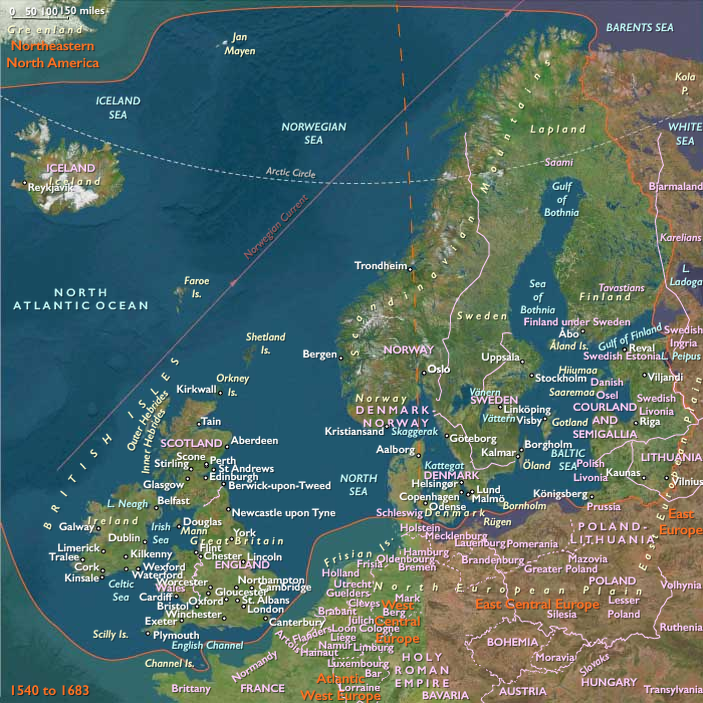
North Europe—spanning Scandinavia, the British Isles, Iceland, the Baltic shores of Finland, Sweden, and Denmark-Norway, and the Low North Sea rim—was a world defined by maritime corridors and cold resilience. The Little Ice Age brought longer winters, crop failures, and stormy seas, but trade, naval innovation, and political centralization propelled the region into prominence. From the Baltic grain ports of Riga and Stockholm to London, Edinburgh, Copenhagen, and Bergen, this northern arc bridged the Atlantic and the Baltic worlds.
Northeast Europe: Baltic Wars and Imperial Rivalries
Political and Military Shifts
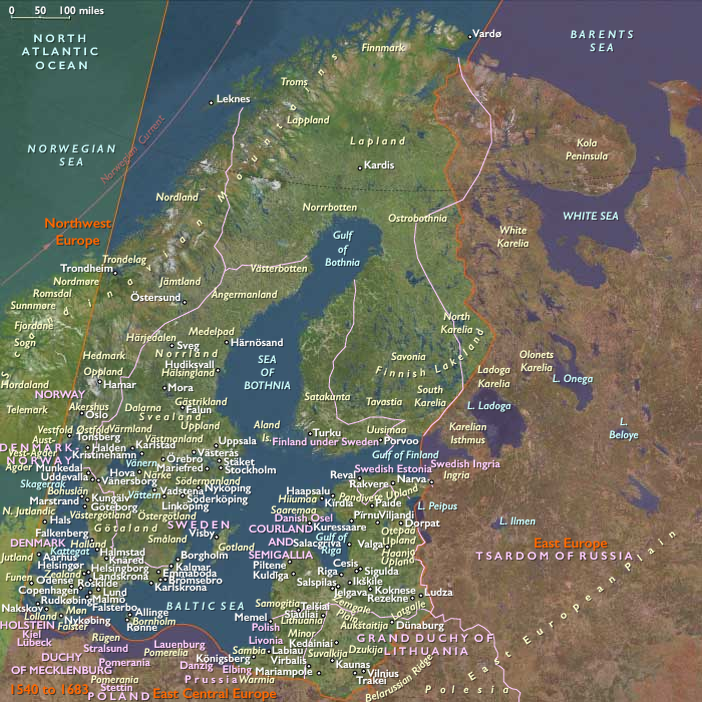
The Baltic became Europe’s most contested inland sea.
-
Sweden’s ascent under Gustavus Adolphus and his successors transformed it into a great power. Victories in the Livonian War (1558–1583) and later in the Thirty Years’ War (1618–1648) secured dominance from Estonia and Livonia to northern Germany.
-
Denmark-Norway, once the senior Nordic realm, waged recurrent wars with Sweden—the Northern Seven Years’ War (1563–1570) and Kalmar War (1611–1613)—but gradually lost supremacy.
-
Russia, under Ivan IV and later the early Romanovs, pressed westward, seeking Baltic access, only to be checked by Swedish and Polish resistance.
-
The Treaty of Roskilde (1658) marked Sweden’s Baltic zenith, granting control over much of Scandinavia’s southern rim and North German ports.
Reformation and Governance
The Lutheran Reformation redefined the political and cultural life of the north.
-
Sweden-Finland codified Lutheran orthodoxy, promoting literacy through parish schooling. Mikael Agricola’sFinnish Bible (1548) inaugurated Finnish literature.
-
Denmark-Norway became firmly Lutheran under Christian III, integrating church and crown.
-
Baltic provinces retained local German-speaking elites under Swedish rule, creating hybrid governance combining Nordic administration with Baltic feudal hierarchies.
Culture and Education
-
Sweden founded Uppsala University (1477, reformed 1595) and Tartu (1632); parish schools proliferated under the “school ordinance” system.
-
Printing and Bible translation advanced vernacular literacy in Finnish, Estonian, and Swedish.
-
Architecture blended Lutheran austerity with baroque royal splendor, while ballads and folk art preserved pre-Christian motifs beneath Protestant piety.
Economy and Society
Baltic commerce thrived through grain, tar, hemp, and timber exports; Stockholm, Riga, and Gdańsk were crucial hubs. Warfare and conscription, however, strained rural populations; Estonian and Latvian peasants suffered under expanding estates. The Baltic trade integrated deeply into Dutch and English shipping circuits.
Northwest Europe: Reformation, Revolution, and Maritime Empire
Religious Upheaval
The Reformation’s turbulence reshaped England, Scotland, and Ireland.
-
England’s monarchy oscillated between Catholic and Protestant faiths under Henry VIII, Mary I, and Elizabeth I, before the Anglican Settlement (1559) defined a Protestant state church.
-
Scotland embraced Presbyterianism through John Knox, while Ireland resisted forced Protestantization, remaining a battleground for English control and Catholic identity.
-
The Netherlands’ Calvinism inspired solidarity and migration across the North Sea, linking English Puritans and Dutch reformers.
War, Revolution, and State Formation
-
The English Civil War (1642–1651) and Interregnum under Oliver Cromwell ended with the execution of Charles I (1649) and the establishment of a short-lived republic.
-
Cromwell’s Irish conquest (1649–1653) devastated the island, displacing thousands through famine and forced migration.
-
The Restoration (1660) reestablished monarchy, but tensions with James II’s Catholicism led toward the Glorious Revolution (1688) and a constitutional monarchy.
-
Scotland’s Union of Crowns (1603) under James VI & I linked the kingdoms, though national institutions remained distinct.
Colonial and Maritime Expansion
-
English and Dutch seafarers spearheaded the Age of Global Navigation:
-
The English East India Company (1600) and the Dutch VOC (1602) created global trade empires.
-
English colonies in Virginia (1607) and New England (1620)**, Dutch New Amsterdam (1625), and later Caribbean holdings expanded Atlantic wealth.
-
-
Maritime trade made London, Amsterdam, and Bristol centers of finance and empire. The Dutch Stock Exchange and Bank of Amsterdam modeled modern capitalism.
Science and Culture
-
The Scientific Revolution reshaped thought: Francis Bacon, Robert Boyle, and Isaac Newton revolutionized natural philosophy; the Royal Society (1660) institutionalized inquiry.
-
Literature and art flourished: Shakespeare, Milton, and Donne in England; Rembrandt, Vermeer, and Spinoza in the Netherlands.
-
High literacy and printing fueled public discourse; coffeehouses and pamphlets became laboratories of early Enlightenment debate.
Environmental and Social Conditions
The Little Ice Age caused frequent harvest failures and fisheries decline, yet maritime economies and trade offset scarcity. Scandinavian forest exports and North Sea fisheries (cod, herring) sustained food supplies. Urbanization and commercial wealth widened social divisions: prosperous merchants contrasted sharply with impoverished rural tenants displaced by enclosures and war.
Legacy and Transition (1540–1683)
By the late 17th century, North Europe had emerged as a powerhouse of Protestant monarchies, maritime empires, and scientific thought.
-
Sweden dominated the Baltic but faced overstretch; Russia prepared for resurgence.
-
Denmark-Norway remained cohesive yet overshadowed.
-
England, recovering from civil war, stood poised for imperial expansion and scientific leadership.
-
The Dutch Republic epitomized commercial modernity, with Amsterdam as Europe’s financial capital.
Religious consolidation, constitutional experimentation, and transoceanic ambition defined the age. The North had transformed from a peripheral frontier into a driving force of modern Europe—anchored in trade, literacy, and the restless winds of the Atlantic and Baltic seas.
People
Groups
- Polytheism (“paganism”)
- Finns
- Sami people
- Tavastians
- Karelians
- Estonians
- Balts
- Latvians, or Letts (Eastern Balts)
- Sweden, Kingdom of
- Christians, Roman Catholic
- Finland under Swedish rule
- Riga, Bishopric/Archbishopric of
- Terra Mariana (Livonian Confederation)
- Estonia, Danish
- Ordensstaat (Monastic state of the Teutonic Knights)
- Livonian Order
- Estonian Swedes
- Hanseatic League
- Denmark, Kingdom of (Personal Union of Denmark and Norway)
- Poland of the Jagiellonians, Kingdom of
- Lithuania, Grand Duchy of
- Kalmar Union (of Denmark, Norway and Sweden)
- Holy Roman Empire
- Lutheranism
- Protestantism
- Kalmar Union (of Denmark and Norway)
- Prussia, Duchy of
- Denmark-Norway, Kingdom of
- Russia, Tsardom of
- Swedish Empire
- Polish-Lithuanian Commonwealth (Commonwealth of the Two Nations)
- Finland, (Swedish) Grand Duchy of
- Pomerania, Swedish
- New Sweden (Swedish Colony)
- Bremen-Verden
Topics
- Protestant Reformation
- Livonian War
- Northern Seven Years' War
- Polish-Swedish War for Livonia, First
- Kalmar, War of
- Thirty Years' War
- Lützen, Battle of
- Colonization of the Americas, Swedish
Commodoties
Subjects
Regions
Subregions
Related Events
Showing 10 events out of 37475 total
Years: 1540 - 1683
People
Groups
- Polytheism (“paganism”)
- Finns
- Sami people
- Tavastians
- Karelians
- Estonians
- Balts
- Latvians, or Letts (Eastern Balts)
- Sweden, Kingdom of
- Christians, Roman Catholic
- Finland under Swedish rule
- Riga, Bishopric/Archbishopric of
- Terra Mariana (Livonian Confederation)
- Estonia, Danish
- Ordensstaat (Monastic state of the Teutonic Knights)
- Livonian Order
- Estonian Swedes
- Hanseatic League
- Denmark, Kingdom of (Personal Union of Denmark and Norway)
- Poland of the Jagiellonians, Kingdom of
- Lithuania, Grand Duchy of
- Kalmar Union (of Denmark, Norway and Sweden)
- Holy Roman Empire
- Lutheranism
- Protestantism
- Kalmar Union (of Denmark and Norway)
- Prussia, Duchy of
- Denmark-Norway, Kingdom of
- Russia, Tsardom of
- Swedish Empire
- Polish-Lithuanian Commonwealth (Commonwealth of the Two Nations)
- Finland, (Swedish) Grand Duchy of
- Pomerania, Swedish
- New Sweden (Swedish Colony)
- Bremen-Verden
Topics
- Protestant Reformation
- Livonian War
- Northern Seven Years' War
- Polish-Swedish War for Livonia, First
- Kalmar, War of
- Thirty Years' War
- Lützen, Battle of
- Colonization of the Americas, Swedish
Commodoties
Subjects
Regions
Subregions