
Elizabeth I and the Portuguese Succession Crisis:…
January 1588 CE
Elizabeth I and the Portuguese Succession Crisis: A Strategic Gamble (1580s)
By the 1580s, the Portuguese Empire—including Brazil, the East Indies, India, and trading posts in China—was under Spanish control, following Philip II’s annexation of Portugal in 1580. Seeking to counter Spanish power in Europe and gain access to Portugal’s trade routes, Queen Elizabeth I of England considered an alliance with Portugal’s exiled pretender, Dom António, Prior of Crato.
Elizabeth I’s Interest in the Portuguese Empire
- Elizabeth’s chartered ships were instructed to purchase the finest Indian opium and transport it back to England, signaling an early English interest in the lucrative Asian trade controlled by the Portuguese.
- By securing an alliance with the Portuguese crown, Elizabeth hoped to:
- Disrupt Spain’s maritime dominance.
- Break Spanish control over Portugal’s trade networks in Asia and the Americas.
- Open commercial opportunities for English merchants and privateers.
The Portuguese Succession Crisis and Dom António’s Weak Position
- Philip II of Spain had been accepted as King of Portugal in 1580 by the Portuguese nobility, particularly due to:
- His superior military strength.
- His pledge to maintain Portuguese autonomy under the Iberian Union.
- Dom António, Prior of Crato, the last surviving male of the House of Aviz, sought to reclaim the throne with foreign assistance.
Dom António’s Disadvantages
- Illegitimacy: His claim was weaker than that of Philip II or even Catherine, Duchess of Braganza, who had strong noble backing.
- Lack of Charisma and Political Acumen:
- He failed to establish a stable government in exile, even in the Azores, which remained his last stronghold against Spain.
- Unlike the Braganza family, he lacked widespread support among the nobility.
- Constant Danger from Spanish Assassins:
- Philip II sent agents to eliminate him, forcing him to move from one refuge to another before finally seeking asylum in England.
Elizabeth’s Support for Dom António
- Elizabeth I favored Dom António for the same reasons as Catherine de’ Medici—as a useful tool against Spain rather than a genuinely viable ruler.
- While Dom António secured English naval backing, his campaigns to reclaim Portugal were ultimately unsuccessful, as:
- The Portuguese aristocracy had largely accepted Spanish rule.
- His military expeditions were poorly executed, particularly the 1589 English-led attack on Lisbon, which failed to rally Portuguese support.
Conclusion: An English Gamble That Failed
Elizabeth’s attempts to use Dom António to challenge Spanish control over Portugal ultimately failed, as Portuguese nobles preferred Philip II over a weak, illegitimate claimant. However, the Anglo-Portuguese connection laid the groundwork for future English influence in Portuguese trade and maritime affairs, particularly in India, the East Indies, and China, where England would later establish its own commercial empire.
Locations
People
Groups
Topics
Commodities
Subjects
Regions
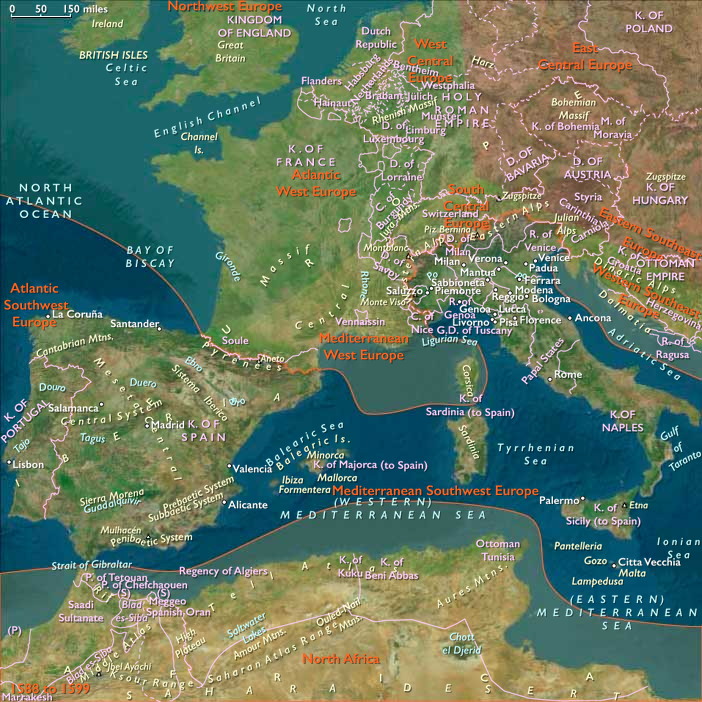
Southwest Europe
View →Subregions
