
Maritime East Africa (1396–1539 CE): Swahili Port …
Years: 1396 - 1539
Maritime East Africa (1396–1539 CE): Swahili Port Cities, Indian Ocean Crossroads, and Portuguese Disruption
Geographic & Environmental Context
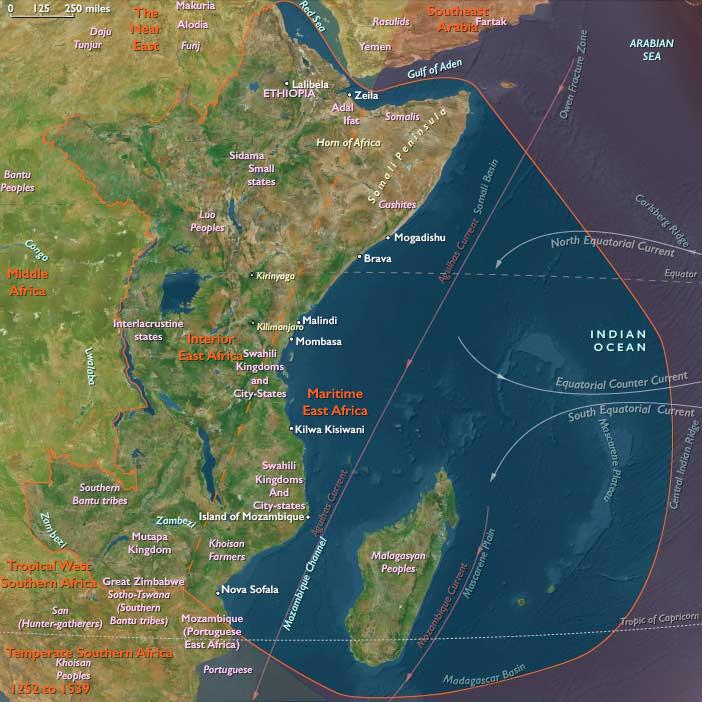
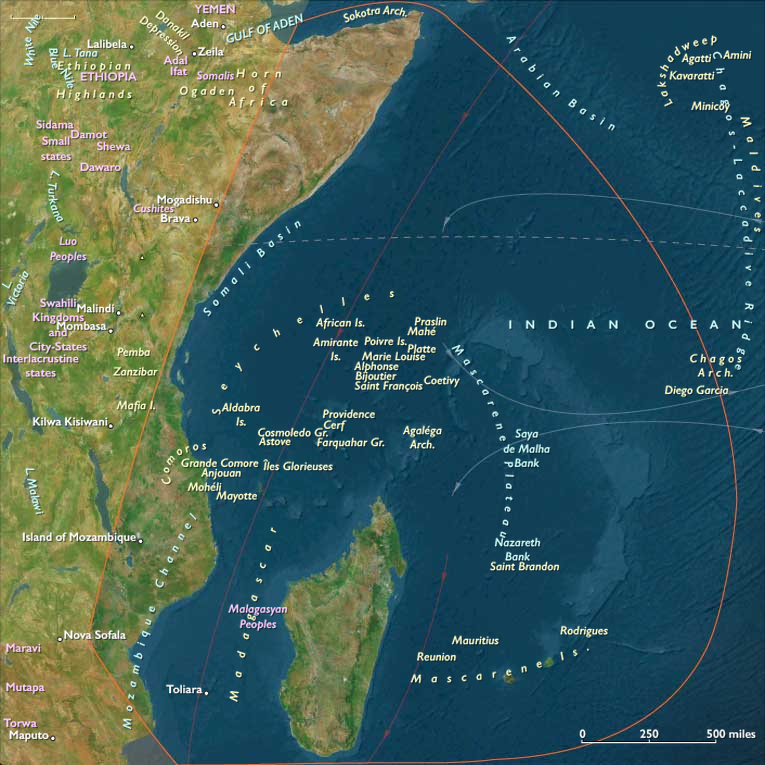
The subregion of Maritime East Africa includes Somalia, eastern Ethiopia, eastern Kenya, eastern Tanzania and its islands, northern Mozambique, the Comoros, Madagascar, Mauritius, and Seychelles. Anchors included the Swahili port cities of Mogadishu, Mombasa, Kilwa, and Sofala; the offshore islands of Zanzibar, Pemba, Comoros, Mauritius, and Seychelles; the coral rag coasts and mangrove estuaries of the western Indian Ocean; and the Madagascar highlands and east coast lagoons. This littoral world linked African hinterlands to the monsoon-sailed sea lanes of Arabia, India, and beyond.
Climate & Environmental Shifts
During the Little Ice Age, rainfall variability shaped coastal and island agriculture. Monsoon cycles continued to govern navigation—southwesterlies (May–September) carried ships to Africa; northeasterlies (November–March) took them back to Arabia and India. Drought pulses in Madagascar and the Horn stressed herders and farmers, while fertile years produced surpluses of rice, sorghum, bananas, and coconuts. Cyclones struck Mauritius, Seychelles, and Madagascar, but coastal mangroves and lagoons buffered damage.
Subsistence & Settlement
-
Swahili coast towns: Sustained by hinterland trade in ivory, gold, and enslaved people; urban diets mixed millet, rice, fish, and coconuts. Urban elites imported Indian cloth, Persian ceramics, and Arabian dates.
-
Islands (Zanzibar, Comoros): Grew cloves, coconuts, and rice; relied on fishing, inter-island trade, and Swahili culture.
-
Madagascar: Highlanders (Merina ancestors) cultivated rice in terraces; east-coast groups fished lagoons and farmed root crops and bananas; cattle herding spread on western plains.
-
Mauritius and Seychelles: Uninhabited until later European contact; served only as stopovers for sailors, rich in tortoises, seabirds, and timber.
Technology & Material Culture
Coral-stone mosques, minarets, and houses with carved wooden doors defined Swahili towns. Iron tools, beads, and cloth moved inland via caravans. Indian Ocean dhows carried cargo under triangular lateen sails. Pottery, brass, and glassware were imported luxuries, while local blacksmiths and woodworkers supplied tools, boats, and weapons. In Madagascar, rice terraces and irrigation systems supported growing populations; cattle herders developed corrals and iron-tipped spears.
Movement & Interaction Corridors
-
Caravan routes: Linked Sofala to goldfields of Zimbabwe, Kilwa to ivory and slaves from the interior, and Mogadishu to Horn hinterlands.
-
Maritime lanes: Connected ports to Arabia, Gujarat, and the Persian Gulf. Kilwa’s merchants traded gold and ivory for Indian cottons and Chinese porcelain.
-
Islands: Comoros acted as mid-ocean trading hubs; Madagascar exported cattle, rice, and slaves to the coast; Mauritius and Seychelles were navigational markers.
-
Portuguese arrival: In 1498, Vasco da Gama reached the Swahili coast, anchoring at Malindi. By the early 1500s, Portuguese fleets attacked Kilwa, Mombasa, and Sofala, building forts at Sofala (1505) and Kilwa, and capturing Mombasa (1505, again in 1528) to insert themselves into the Indian Ocean system.
Cultural & Symbolic Expressions
The Swahili culture, Islamic yet distinctly African, flourished in mosques, madrasas, and Arabic-script chronicles. Poetry and oral tradition blended Arabic and Bantu elements. Courtly elites displayed imported porcelain, glass, and silks as symbols of cosmopolitan legitimacy. In Madagascar, ancestor veneration, megalithic tombs, and sacred cattle rituals defined highland cosmology. Comorian Islam blended with local traditions; mosque festivals and dhikr recitations marked communal time.
Environmental Adaptation & Resilience
Coastal communities hedged risk with diversified subsistence—fish, coconuts, and rice. Trade redistributed grain and cloth during scarcity. Malagasy farmers terraced slopes for rice, herders spread cattle across grazing zones, and islanders planted drought-resistant crops like millet and cassava (newly diffused but not yet widespread). Coral and mangrove ecosystems supplied building material and coastal defense.
Technology & Power Shifts (Conflict Dynamics)
Swahili city-states, linked to the wider Islamic world, relied on merchant oligarchies and sultanates. Intercity rivalries flared, but prosperity endured until Portuguese cannon disrupted trade. From 1505 onward, Portuguese seized Sofala and Kilwa, raided Mombasa, and sought to monopolize gold, ivory, and spice routes. Resistance persisted, but Portuguese forts and cartazes (pass systems) forced Swahili merchants into their empire. Madagascar polities grew more stratified; cattle-raiding and rice-tribute intensified around emerging highland centers.
Transition
By 1539 CE, Maritime East Africa stood at a crossroads. Swahili port cities still thrived on cosmopolitan trade, but Portuguese intrusion threatened their autonomy. Madagascar’s highlands and coasts were consolidating into distinct cultural spheres. Comoros balanced local subsistence with regional trade, while Mauritius and Seychelles remained untouched but mapped. The Indian Ocean world was shifting—Africa’s maritime corridor had entered the age of European cannon empires.
Groups
- Khoisan
- Austronesian peoples
- Bantu peoples
- Arab people
- Omanis
- Somalis
- Madagascar
- Nilotic peoples
- Persian Empire, Sassanid, or Sasanid
- Merina people
- Swahili people
- Comoro Islands
- Islam
- Kilwa Sultanate
- Portugal, Avizan (Joannine) Kingdom of
Commodoties
Subjects
Regions
Subregions
Related Events
Showing 10 events out of 43406 total
Years: 1396 - 1539
Groups
- Khoisan
- Austronesian peoples
- Bantu peoples
- Arab people
- Omanis
- Somalis
- Madagascar
- Nilotic peoples
- Persian Empire, Sassanid, or Sasanid
- Merina people
- Swahili people
- Comoro Islands
- Islam
- Kilwa Sultanate
- Portugal, Avizan (Joannine) Kingdom of
Commodoties
Subjects
Regions
Subregions