
West Central Europe (1396–1539 CE): Riverine …
Years: 1396 - 1539
West Central Europe (1396–1539 CE): Riverine Corridors, Printing Revolutions, and Reformation Fires
Geography & Environmental Context
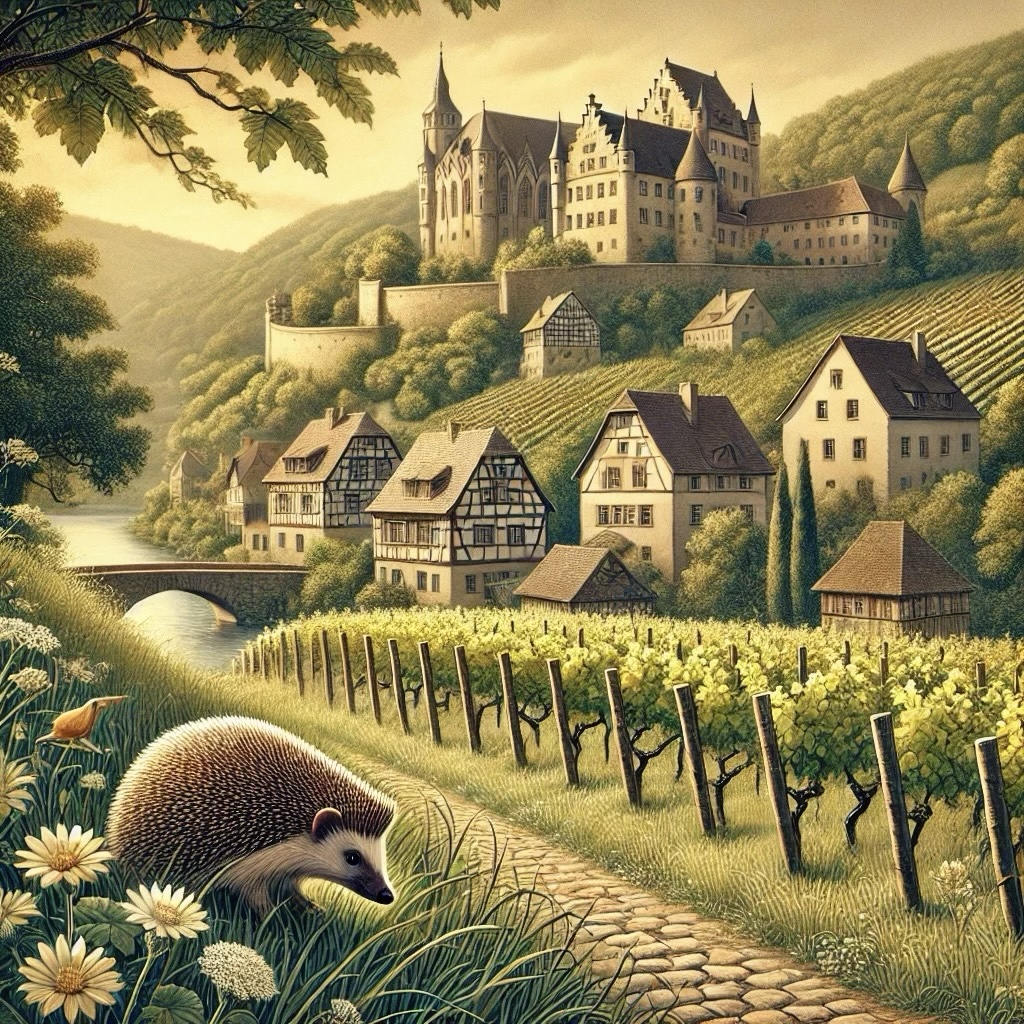
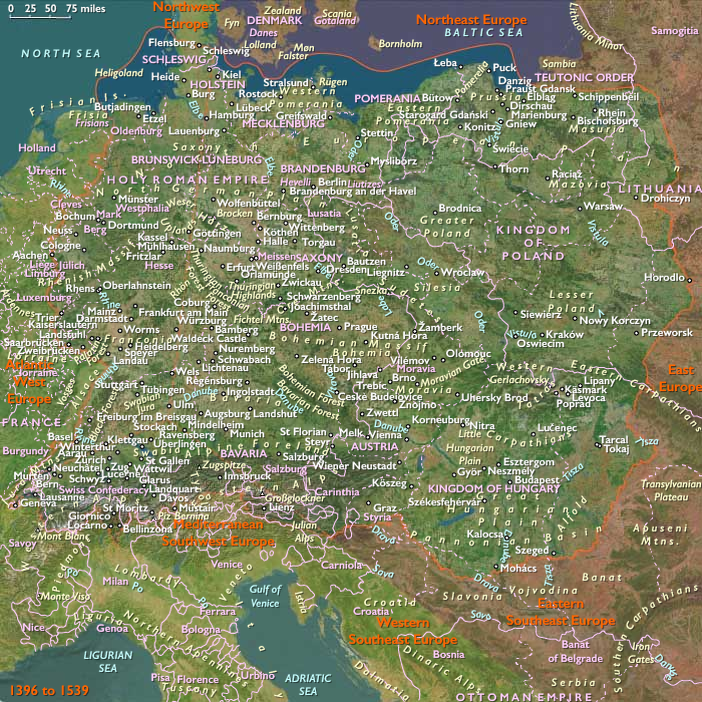
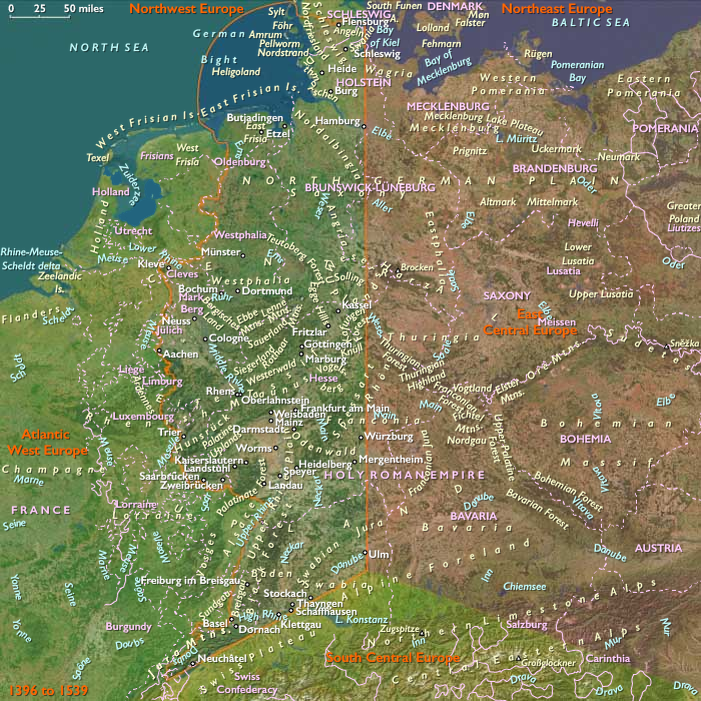
West Central Europe comprises modern Germany west of 10°E and the Rhine-adjacent far northwest of Switzerland, including the northern Jura. Anchors include the Middle and Upper Rhine Valley, the Moselle and Main tributaries, the Eifel and Hunsrück uplands, the northern Black Forest, and the northern Jura. Fertile alluvial plains along the Rhine, vineyard slopes on the Moselle, and wooded hills provided diverse resources. Major cities such as Cologne, Mainz, Worms, Speyer, Strasbourg, Basel, and Heidelberg sat astride river corridors that tied inland markets to the Low Countries and beyond.
Climate & Environmental Shifts
The Little Ice Age shaped harvests and settlement. Colder winters shortened the growing season, particularly in uplands, while floods periodically transformed the Rhine and Main valleys. Viticulture faced difficult vintages, though wine remained a cornerstone of the economy. Grain shortages in the early 1500s sharpened social tensions. Urban centers buffered these stresses through imports of Baltic grain and southern wine, but rural communities bore the brunt of climatic volatility.
Subsistence & Settlement
Villages dotted valleys and plateaus, growing rye, barley, oats, and wheat alongside vineyards. Livestock—cattle, pigs, and sheep—added resilience. Towns prospered as centers of trade, crafts, and ecclesiastical authority. Cologne, the region’s largest city, thrived on cloth, wine, and salt trade. Mainz and Speyer anchored episcopal power; Strasbourg and Basel became commercial and cultural hubs. Heidelberg flourished as a university town and princely seat. Population recovery after the late medieval crisis pressed on land and fueled both rural migration and urban expansion.
Technology & Material Culture
West Central Europe was a crucible of innovation and artistry:
-
Around 1450, Johannes Gutenberg of Mainz perfected movable type printing, unleashing an information revolution. By the early 1500s, presses in Cologne, Strasbourg, and Basel flooded Europe with books, pamphlets, and woodcuts.
-
Stoneware pottery from Siegburg and Raeren circulated widely.
-
Castles and fortifications adapted to gunpowder weaponry, with bastions and artillery towers altering the skyline.
-
Gothic cathedrals remained symbolic focal points—Cologne Cathedral’s soaring nave, Strasbourg’s spire, and Basel’s Münster—while Renaissance influences filtered into painting, sculpture, and architecture.
Movement & Interaction Corridors
The Rhine River was the great artery, connecting Basel to Cologne and onward to the North Sea. The Moselle and Main linked Rhineland towns with Franconia and beyond. Overland routes crossed the Black Forest and Jura, carrying merchants, pilgrims, and imperial envoys. Pilgrimage sites such as Cologne and Trier drew travelers from across Christendom. The patchwork geography of the Holy Roman Empire fostered constant mobility—imperial diets, princely courts, university students, and merchants all circulated along these corridors.
Cultural & Symbolic Expressions
Religious and intellectual ferment marked the era:
-
The Council of Basel (1431–1449) underscored debates over church authority.
-
Heidelberg University became a hub of humanist scholarship, while Basel attracted figures like Erasmus.
-
The Reformation erupted from 1517 onward: Luther’s theses spread rapidly through West Central Europe’s presses. The Diet of Worms (1521) dramatized the confrontation between Luther and Emperor Charles V.
-
Pamphlets, woodcuts, and vernacular Bibles reshaped religious culture, while hymns and polemics circulated among towns and villages.
-
Popular culture remained vigorous: carnival processions, market fairs, and guild rituals marked civic and seasonal rhythms.
Environmental Adaptation & Resilience
Farmers diversified crops and managed vineyards to buffer against cold snaps. Urban councils stockpiled grain and regulated bread prices to stabilize food security. Guilds and confraternities provided mutual aid in times of famine or plague. Despite these strategies, plague outbreaks and rural discontent persisted, especially during lean harvests. Communities relied on both religious charity and secular regulation to survive recurrent crises.
Transition
Between 1396 and 1539, West Central Europe moved from late medieval recovery into the upheavals of the early modern era. Fertile valleys and trade routes underpinned prosperity, while its cities fostered printing, humanism, and reform. Yet these same corridors carried conflict: the Peasants’ War (1524–1526) erupted in Swabia and Franconia, demanding social and religious justice, only to be crushed by princely armies. By mid-century, West Central Europe was no longer simply a prosperous crossroads of medieval Christendom—it was a contested heartland where presses, pulpits, and battlefields all heralded the transformations of the modern world.
West Central Europe (with civilization) ©2024-25 Electric Prism, Inc. All rights reserved.
People
Groups
- Jews
- Mainz, Electoral Archbishopric of
- Worms, Bishopric of
- Speyer, Prince-Bishopric of
- Trier, Electorate of
- Cologne, Electorate of
- Lorraine (Lothier), Upper, Duchy of
- Lorraine (Lotharingia), Lower, (first) Duchy of
- Germany, Kingdom of (within the Holy Roman Empire)
- German, or Ottonian (Roman) Empire
- Holy Roman Empire
- Burgundy, County of
- Basel, Prince-Bishopric of
- Burgundy, Duchy of
- Lorraine, (second) Duchy of
- Lorraine (Lothier), Lower, (second) Duchy of
- Christians, Roman Catholic
- Cistercians, Order of the (White Friars)
- Würzburg, Bishopric of
- Franciscans, or Order of St. Francis
- Dominicans, or Order of St. Dominic
- Frankfurt am Main, Imperial Free City of
- Speyer, Prince-Bishopric of
Topics
Commodoties
- Hides and feathers
- Domestic animals
- Grains and produce
- Textiles
- Fibers
- Ceramics
- Strategic metals
- Salt
- Beer, wine, and spirits
- Lumber
- Manufactured goods
- Spices
Subjects
- Commerce
- Architecture
- Public health
- Decorative arts
- Conflict
- Mayhem
- Faith
- Government
- Custom and Law
- Catastrophe
- Metallurgy
Regions
Subregions
Related Events
Showing 10 events out of 43406 total
Years: 1396 - 1539
West Central Europe (with civilization) ©2024-25 Electric Prism, Inc. All rights reserved.
People
Groups
- Jews
- Mainz, Electoral Archbishopric of
- Worms, Bishopric of
- Speyer, Prince-Bishopric of
- Trier, Electorate of
- Cologne, Electorate of
- Lorraine (Lothier), Upper, Duchy of
- Lorraine (Lotharingia), Lower, (first) Duchy of
- Germany, Kingdom of (within the Holy Roman Empire)
- German, or Ottonian (Roman) Empire
- Holy Roman Empire
- Burgundy, County of
- Basel, Prince-Bishopric of
- Burgundy, Duchy of
- Lorraine, (second) Duchy of
- Lorraine (Lothier), Lower, (second) Duchy of
- Christians, Roman Catholic
- Cistercians, Order of the (White Friars)
- Würzburg, Bishopric of
- Franciscans, or Order of St. Francis
- Dominicans, or Order of St. Dominic
- Frankfurt am Main, Imperial Free City of
- Speyer, Prince-Bishopric of
Topics
Commodoties
- Hides and feathers
- Domestic animals
- Grains and produce
- Textiles
- Fibers
- Ceramics
- Strategic metals
- Salt
- Beer, wine, and spirits
- Lumber
- Manufactured goods
- Spices
Subjects
- Commerce
- Architecture
- Public health
- Decorative arts
- Conflict
- Mayhem
- Faith
- Government
- Custom and Law
- Catastrophe
- Metallurgy
Regions
Subregions